Try, learn and adjust
Check every public works participant attends basic training
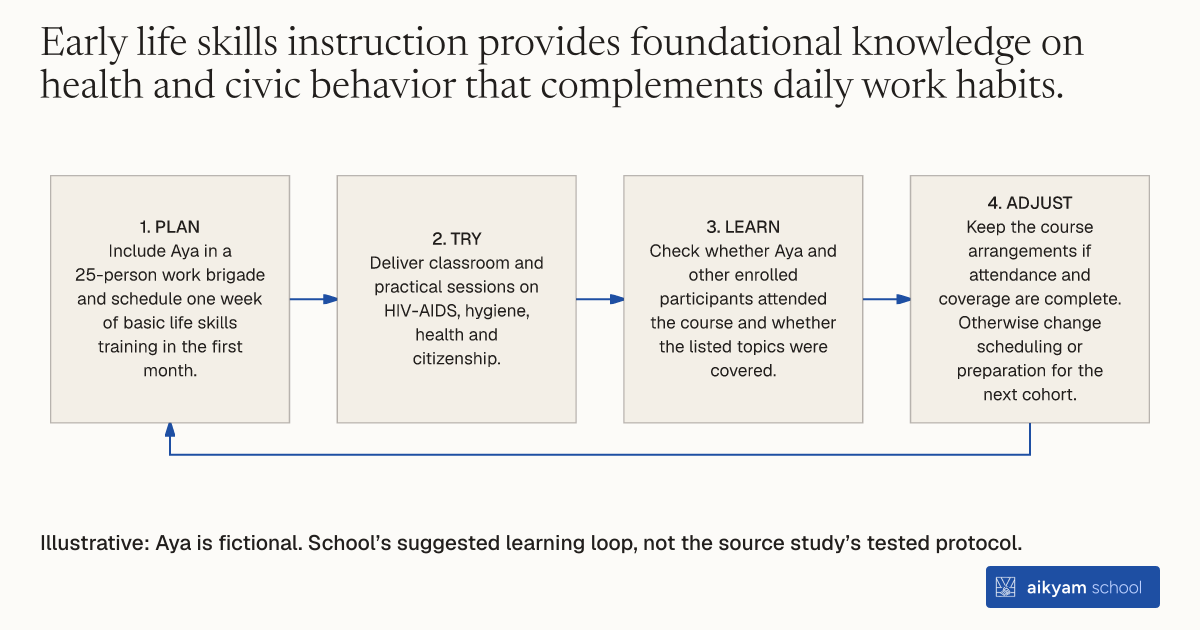
- Plan: Include Aya in a 25-person work brigade and schedule one week of basic life skills training in the first month.
- Try: Deliver classroom and practical sessions on HIV-AIDS, hygiene, health and citizenship.
- Learn: Check whether Aya and other enrolled participants attended the course and whether the listed topics were covered.
- Adjust: Keep the course arrangements if attendance and coverage are complete. Otherwise change scheduling or preparation for the next cohort.
Illustrative: Aya is fictional. School’s suggested learning loop, not the source study’s tested protocol.
See source →Observe course attendance and topic coverage. The source evaluated public works including training, not this course’s separate impact. School’s suggested learning loop; not a tested source procedure.
How
When to use
Urban youth in low-income settings often lack formal orientation on health, hygiene, and workplace citizenship. Temporary public works programs can integrate foundational life skills instruction into early program schedules. This training prepares young workers for structured team environments and healthy daily habits.
Deliver a standardized one-week basic life skills curriculum to all public works beneficiaries shortly after enrollment.
- Enroll public works participants into local work brigades of 25 individuals.
- Schedule a dedicated one-week training course during the first month of program participation.
- Conduct classroom and practical sessions covering HIV-AIDS awareness and prevention.
- Deliver instruction on personal hygiene and health practices relevant to daily manual work.
- Provide lessons on citizenship, civic responsibilities, and constructive workplace behavior.
Why it works
Delivering training in small cohorts strengthens team cohesion and establishes basic conduct standards for temporary public employment.
Example
In Côte d'Ivoire, 3,125 urban youth participating in the PEJEDEC public works program received the one-week basic life skills training in August 2013, one month after starting road maintenance work. The training covered HIV-AIDS, citizenship, and hygiene across 16 urban localities. All beneficiaries attended the course while remaining enrolled in seven-month public works employment.
About the study
Participants
4,160 urban youth aged 18 to 30 years across 16 localities in Côte d'Ivoire, with 43% women and 49% having not completed primary school.
Study Design
Randomized controlled trial evaluating 3,125 public works participants who all received the basic life skills training against a control group of 1,035 non-selected applicants.
Results
At midline (4 to 5 months in), the overall public works program including life skills training increased the psychological well-being index by 0.20 standard deviations and improved the behavior index by 0.12 standard deviations. Impulsiveness decreased by 0.095 standard deviations and anger decreased by 0.13 standard deviations during participation.