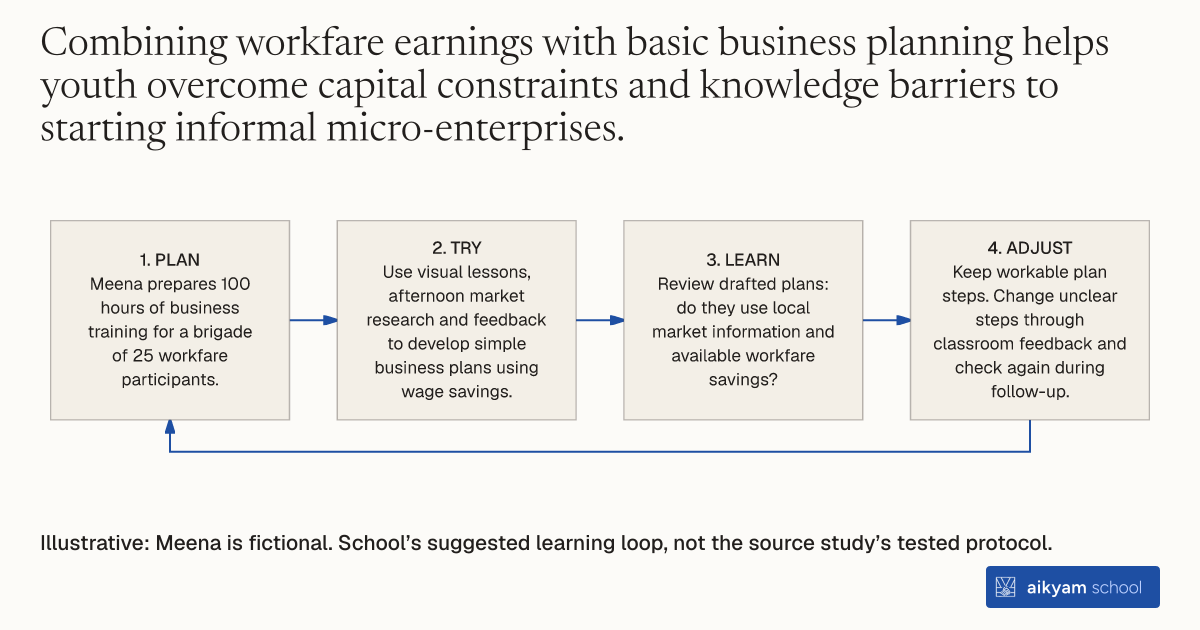
Try, learn and adjust
Check practical business plan preparation
- Plan: Meena prepares 100 hours of business training for a brigade of 25 workfare participants.
- Try: Use visual lessons, afternoon market research and feedback to develop simple business plans using wage savings.
- Learn: Review drafted plans: do they use local market information and available workfare savings?
- Adjust: Keep workable plan steps. Change unclear steps through classroom feedback and check again during follow-up.
Illustrative: Meena is fictional. School’s suggested learning loop, not the source study’s tested protocol.
See source →Observe drafted plans and market research. School suggests this learning loop; higher total earnings were not statistically established against public works alone.
How
When to use
Low-skilled urban youth participating in temporary public works programs often transition back into low-earning informal self-employment once public employment ends. Complementary entrepreneurship instruction builds core business management skills and business planning capacity during the workfare program. This intervention serves underemployed young public works beneficiaries seeking to launch or expand small non-agricultural micro-enterprises using accumulated workfare savings.
Deliver a 100-hour basic entrepreneurship training course to public works beneficiaries in cohorts of 25 workers during the final month of program participation.
- Form workfare participants into 25-person brigades and schedule 100 hours of tailored business instruction across two two-week classroom periods.
- Teach foundational cross-cutting business and financial management skills using visual and non-literate curricula adapted for low-skill youth.
- Assign participants individual field research tasks during afternoon hours to gather market information and identify viable local business opportunities.
- Guide beneficiaries through drafting simple, practical business plans tailored to small-scale enterprises that can be capitalized using public works wage savings.
- Provide classroom feedback on drafted business plans and deliver post-training follow-up sessions to support small business startup.
Why it works
Visual training materials enable low-educated participants to acquire practical business management knowledge and systematically structure new commercial activities.
Example
In Côte d'Ivoire, 1,000 public works participants organized into 40 brigades received 100 hours of complementary basic entrepreneurship training during the seventh month of their workfare contract. Entrepreneurship knowledge improved by 0.11 standard deviations, and business plan preparation increased by 4 percentage points (an 80% relative increase over the control group average of 5%). However, this did not translate into statistically significant higher total post-program earnings compared to public works alone.
About the study
Participants
4,160 urban youth aged 18 to 30 years across 16 localities in Côte d'Ivoire, with 1,000 beneficiaries assigned to the public works plus basic entrepreneurship training arm.
Study Design
Randomized controlled trial using a two-stage design: individual lottery selection into public works followed by brigade-level randomization into training arms, evaluated 12 to 15 months post-program.
Results
Basic entrepreneurship training increased business knowledge by 0.11 standard deviations and increased the likelihood of preparing a business plan by 4.1 percentage points from a control baseline of 5%. Post-program self-employment earnings showed positive point estimates in levels (CFA 5,595 additional earnings) but total post-program earnings (CFA 4,229 additional earnings) were not statistically significantly different from pure public works alone.