Try, learn and adjust
Check repayment entries reach the database
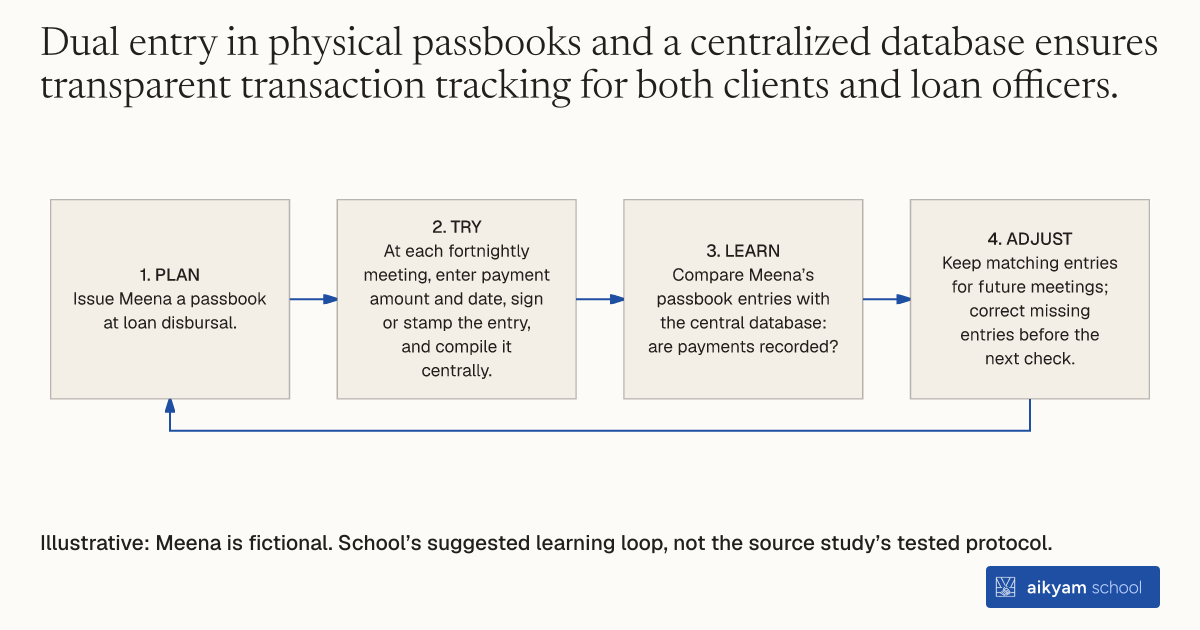
- Plan: Issue Meena a passbook at loan disbursal.
- Try: At each fortnightly meeting, enter payment amount and date, sign or stamp the entry, and compile it centrally.
- Learn: Compare Meena’s passbook entries with the central database: are payments recorded?
- Adjust: Keep matching entries for future meetings; correct missing entries before the next check.
Illustrative: Meena is fictional. School’s suggested learning loop, not the source study’s tested protocol.
See source →School’s suggested learning loop: Observe payment amounts, dates and central records. This loop does not establish default effects.
How
When to use
Low-income microfinance clients make recurring loan payments during regular group meetings. Lenders and evaluators need reliable transaction records to monitor client delinquency and default across loan cycles. Standardizing passbook entries and central database recording enables accurate tracking of repayment amounts and dates.
Record client loan installment payments in physical borrower passbooks and synchronize entries into a centralized database.
- Issue a physical paper passbook to each borrowing client at loan disbursal.
- Collect fixed cash installment payments during biweekly group repayment meetings.
- Write the exact payment amount and date directly into the client's passbook during the meeting.
- Sign or stamp the passbook entry as an official administrative receipt of payment.
- Compile passbook transaction records into a centralized administrative database maintained through the end of the follow-up period.
Why it works
Systematic record-keeping prevents disputed payments and creates verifiable administrative data for delinquency analysis.
Example
Village Financial Services loan officers recorded biweekly loan payments in client passbooks for 845 female borrowers in Kolkata through January 2010. Administrative passbook tracking revealed that grace period clients had a 5.4 percent default rate compared to 1.6 percent for regular contract clients 24 weeks after loan due dates.
About the study
Participants
845 low-income female microfinance clients in 169 loan groups in Kolkata, India.
Study Design
Longitudinal tracking using administrative passbook records compiled into a centralized MFI database through January 2010.
Results
Passbook administrative tracking recorded repayment history through at least 52 weeks past due dates for all 845 clients, revealing default rates of 1.65 percent for regular clients versus 6.42 percent for grace period clients at 24 weeks post-due date, and outstanding unpaid balances averaging 69.65 rupees versus 218.65 rupees at 52 weeks post-due date.