Research steps
Track residential moves through existing records
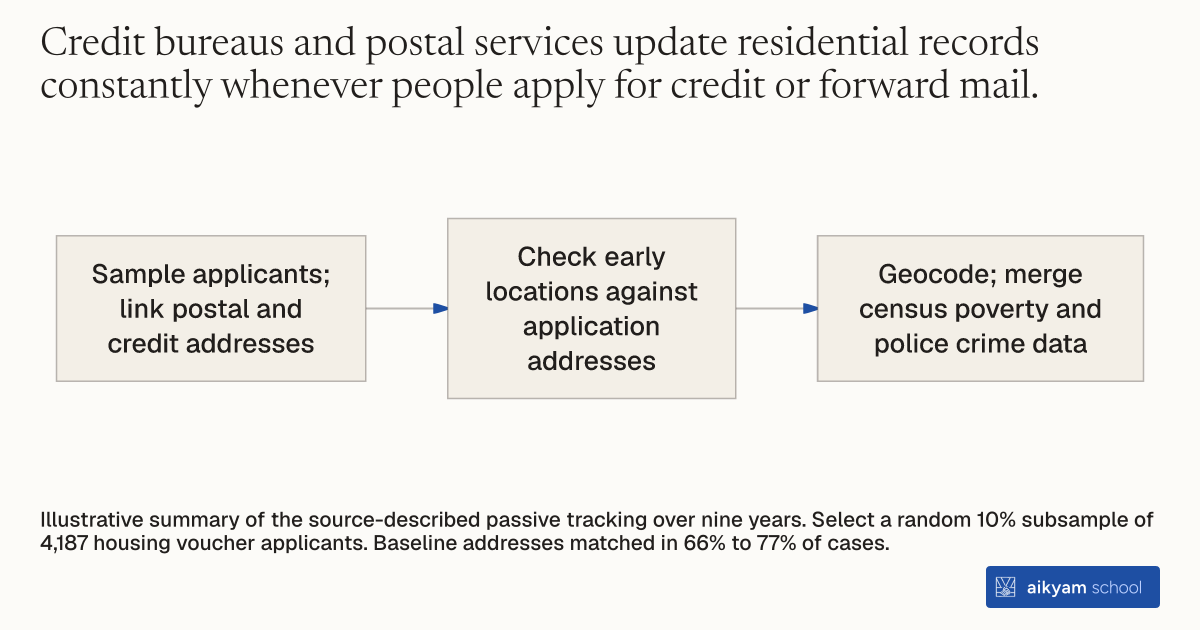
- Sample applicants; link postal and credit addresses
- Check early locations against application addresses
- Geocode; merge census poverty and police crime data
Illustrative summary of the source-described passive tracking over nine years. Select a random 10% subsample of 4,187 housing voucher applicants. Baseline addresses matched in 66% to 77% of cases.
See source →How
When to use
Direct contact with study participants can become difficult over multi-year evaluation periods. Passive address tracking locates relocated subjects without active survey outreach. This method measures neighborhood mobility and environmental changes for program participants.
Track participant residential movement passively by matching personal identifiers against commercial and postal address databases.
- Draw a representative random sample of program applicants from intake records.
- Link participant names, Social Security numbers, and birth dates to National Change of Address registry files.
- Match applicant records against commercial national credit bureau address history files.
- Verify address accuracy by checking earliest identified locations against baseline application addresses.
- Geocode verified addresses to census block groups and police beat boundaries.
- Merge geocoded locations with local census poverty data and police crime statistics to measure neighborhood environment quality over time.
Why it works
Accessing these existing registries eliminates active survey costs and prevents participant dropout bias.
Example
Researchers in Chicago, Illinois, selected a random ten percent subsample of 4,187 housing voucher applicants and tracked their address histories across nine years using national change of address records and credit bureau files.
About the study
Participants
4,187 households (random 10 percent subsample of Chicago housing voucher lottery applicants); Chicago, Illinois.
Study Design
Passive longitudinal address linkage merged with 2000 Census block group poverty data and Chicago Police Department crime statistics.
Results
Passive tracking matched application addresses in 66 to 77 percent of baseline cases and revealed that housing vouchers had no statistically significant impact on total addresses lived at (0.119 IV difference) or census tract poverty rates (-0.009 IV difference).