Research steps
Vary piece rates while offsetting base pay
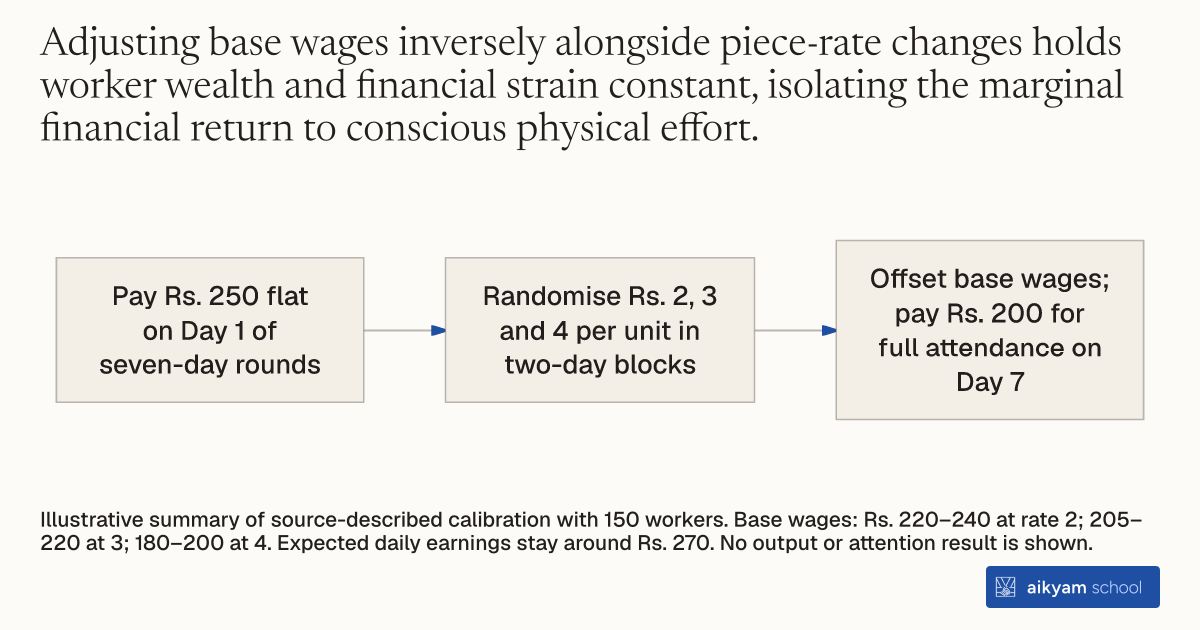
- Pay Rs. 250 flat on Day 1 of seven-day rounds
- Randomise Rs. 2, 3 and 4 per unit in two-day blocks
- Offset base wages; pay Rs. 200 for full attendance on Day 7
Illustrative summary of source-described calibration with 150 workers. Base wages: Rs. 220–240 at rate 2; 205–220 at 3; 180–200 at 4. Expected daily earnings stay around Rs. 270. No output or attention result is shown.
See source →How
When to use
Test whether worker productivity changes stem from conscious physical effort or automatic mental focus in real-effort tasks. Standard wage increases alter wealth and financial strain alongside work motivation, making it difficult to separate physical exertion from mental focus. It serves researchers, labor economists, and incentive designers calibrating workplace compensation schemes.
Isolate conscious effort from cognitive focus by varying piece-rate wages while adjusting base wages to hold daily earnings constant.
- Re-hire experienced contract workers for 7-day experimental rounds during the agricultural lean season to eliminate initial learning curves.
- Pay all workers a flat daily wage of Rs. 250 with zero piece-rate incentives on Day 1.
- Randomize daily piece rates across the remaining six days across three levels: Rs. 2, Rs. 3, and Rs. 4 per completed unit, assigning each rate for two consecutive days in randomized order across workers.
- Calibrate base wages inversely for each piece-rate level (Rs. 220–240 for Rs. 2; Rs. 205–220 for Rs. 3; Rs. 180–200 for Rs. 4) using baseline productivity data to maintain uniform expected daily earnings around Rs. 270 across all rates.
- Provide a flat attendance bonus of Rs. 200 paid on Day 7 for complete attendance to maintain high attendance without altering daily piece-rate marginal incentives.
Why it works
This reveals whether higher effort motivation alters physical work pace without changing involuntary cognitive focus or attentional errors.
Example
Among 150 male piece-rate leaf-plate makers in rural Odisha, India, researchers varied daily piece rates between Rs. 2, Rs. 3, and Rs. 4 while offsetting base wages. Each Rs. 1 piece-rate increase raised output by 0.020 standard deviations (p=0.042) but produced no change in attentional error rates (-0.013 standard deviations, p=0.198).
About the study
Participants
150 male casual manufacturing workers in Odisha, India (4,374 worker-hour observations across 898 worker-days).
Study Design
Within-subject experimental variation of piece rates (Rs. 2, 3, 4) across 6 workdays with order randomized across workers, adjusting base wages to hold expected daily total earnings constant at ~Rs. 270 alongside a Rs. 200 full-attendance bonus.
Results
Each Rs. 1 piece-rate increase raised output by 0.020 SDs (p=0.042) and a 1% piece-rate increase raised output by 0.058 SDs (p=0.038), while attentiveness index changes were zero or slightly negative (-0.013 SDs, p=0.198; p-value for equality of output vs. attentiveness effects = 0.001).