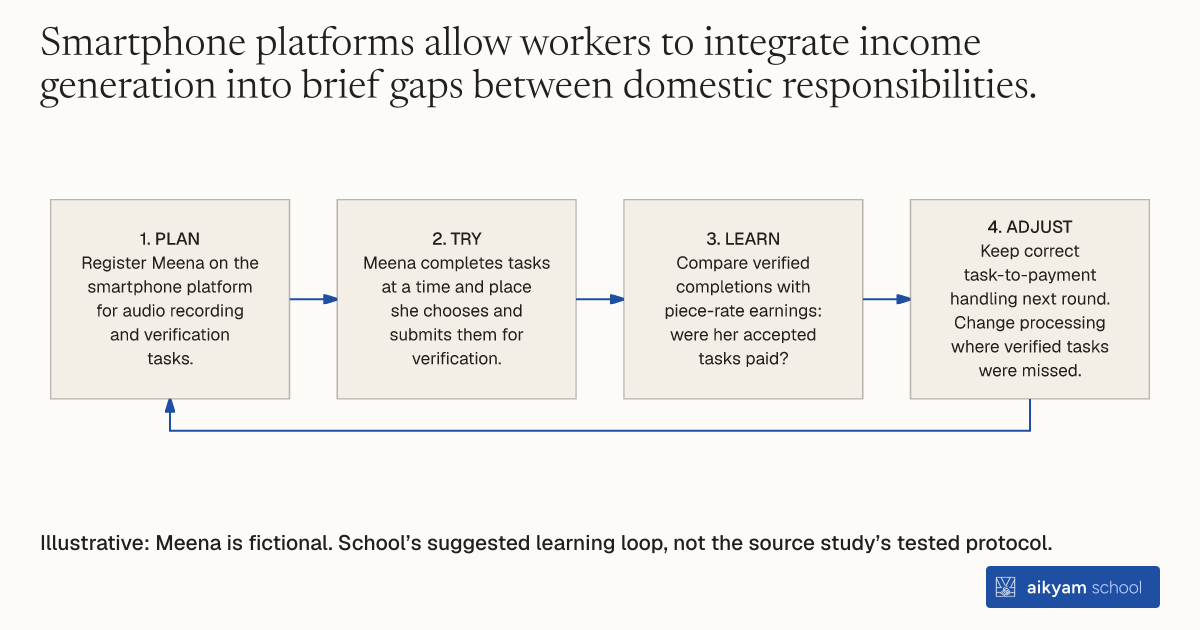
Try, learn and adjust
Check verified tasks reach payment
- Plan: Register Meena on the smartphone platform for audio recording and verification tasks.
- Try: Meena completes tasks at a time and place she chooses and submits them for verification.
- Learn: Compare verified completions with piece-rate earnings: were her accepted tasks paid?
- Adjust: Keep correct task-to-payment handling next round. Change processing where verified tasks were missed.
Illustrative: Meena is fictional. School’s suggested learning loop, not the source study’s tested protocol.
See source →School’s suggested, untested loop. Observe completed tasks, verification and piece-rate payments. This delivery check does not establish employment effects.
How
When to use
Millions of adult women in developing regions remain out of the paid workforce due to household duties and restrictive social norms. Digital micro-task delivery addresses this mismatch by providing earning opportunities through basic personal smartphones. This method serves home-bound caregivers and women who seek flexible income without leaving their home environment.
Deliver short digital micro-tasks to workers through a dedicated smartphone application with per-task piece-rate compensation.
- Platform developers design lightweight task modules such as voice recording in Bengali or Hindi and audio verification on a mobile application.
- Program administrators recruit participants and distribute login credentials to registered smartphone users.
- Workers complete micro-tasks asynchronously from home or any preferred location during available free time.
- Workers submit completed tasks directly through the mobile application for automated or manual verification.
- Program administrators calculate payments based on verified completed tasks at a fixed piece rate and disburse earnings.
Why it works
Direct piece-rate compensation incentivizes task completion without requiring rigid work hours or travel.
Example
Researchers partnered with Project Karya at Microsoft Research in Kolkata, West Bengal, India, where 1,670 women completed audio recording and verification tasks on smartphones, earning up to INR 4,000 (\$52 USD) at a rate of approximately INR 1 (\$0.013 USD) per completed task.
About the study
Participants
1,670 households (women average age 30, 93% married, 48% with young childcare duties, 69% never worked for pay) in rural, peri-urban, and urban Kolkata, West Bengal, India.
Study Design
Randomized controlled trial evaluating job take-up and performance across different work arrangements delivered via a smartphone platform across two 4-week rounds.
Results
Women offered the flexible mobile work arrangement were 33 percentage points (228%) more likely to start work compared to those offered office jobs, where only 14.6 percent started.