Research procedure
Sample rural households and voters
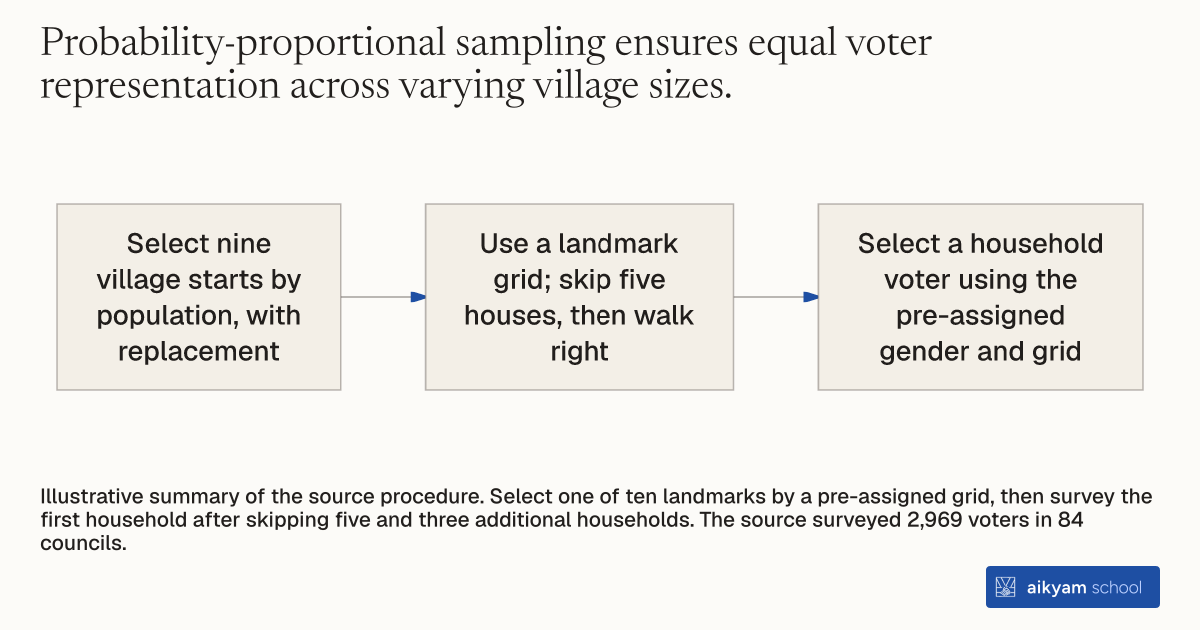
- Select nine village starts by population, with replacement
- Use a landmark grid; skip five houses, then walk right
- Select a household voter using the pre-assigned gender and grid
Illustrative summary of the source procedure. Select one of ten landmarks by a pre-assigned grid, then survey the first household after skipping five and three additional households. The source surveyed 2,969 voters in 84 councils.
See source →How
When to use
Researchers need to conduct a representative household survey across rural administrative units before an election. Standard convenience sampling risks spatial cluster bias and unequal selection probabilities across villages of varying populations. This method selects villages systematically by population size and uses landmark-based Kish grids to randomize household recruitment.
Select survey households using population-proportional village sampling, landmark Kish grid starting points, and household Kish grids.
- Select 9 village starting points per union council with replacement from official bureau of statistics village lists using probability proportional to population size.
- Direct field enumerators to choose one of ten standardized village landmarks using a pre-assigned Kish grid based on union council and village codes.
- Skip five houses to the right of the selected landmark and survey the first household.
- Employ a right-hand walk rule to select and survey three additional households at that starting location.
- List all registered voters of a randomly pre-assigned gender in each household and apply a household Kish grid to select a single respondent.
Why it works
Combining landmark Kish grids with right-hand walking rules prevents enumerators from arbitrarily selecting accessible central households.
Example
Researchers surveyed 2,969 registered voters across 84 rural union councils in Sargodha district during the first two weeks of November 2015, sampling 18 male and 18 female respondents per union council across 9 village starting points.
About the study
Participants
2,969 registered voters (18 males and 18 females per union council) across 84 rural union councils in Sargodha district, Punjab province, Pakistan.
Study Design
Stratified random survey sampling using population-proportional village selection, landmark Kish grids, right-hand household walks, and household voter Kish grids.
Results
The multi-stage sampling design produced well-balanced demographic distributions across experimental arms, including age (38.9 to 40.0 years), education (4.1 to 4.4 years), and cultivable land ownership (3.0 to 3.5 acres).