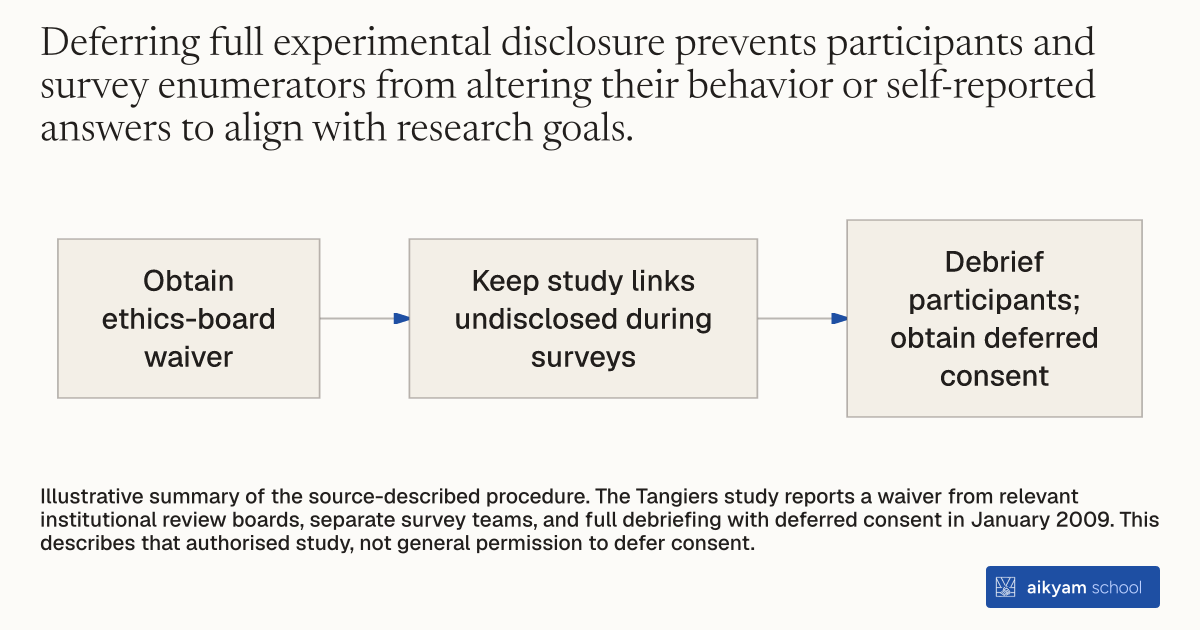
Research steps
Describe deferred consent in the study
- Obtain ethics-board waiver
- Keep study links undisclosed during surveys
- Debrief participants; obtain deferred consent
Illustrative summary of the source-described procedure. The Tangiers study reports a waiver from relevant institutional review boards, separate survey teams, and full debriefing with deferred consent in January 2009. This describes that authorised study, not general permission to defer consent.
See source →How
When to use
In social experiments, informing participants about full research objectives upfront can cause Hawthorne effects or halo bias in survey responses. This method uses an Institutional Review Board waiver of prior informed consent to keep study hypotheses and utility partnerships unrevealed during data collection. It protects research integrity while ensuring full post-study disclosure and deferred participant consent.
Preserve experimental double-blindness using deferred consent protocols authorized by Institutional Review Boards.
- Submit experimental protocols to institutional review boards requesting a waiver of upfront informed consent disclosure.
- Maintain strict separation between implementation partners and survey teams so enumerators remain blind to research objectives.
- Administer baseline, illness tracking, and endline surveys without revealing the experiment's hypothesis or utility partnership to respondents.
- Conduct debriefing sessions at study completion to explain the full research design and marketing experiment to all participants.
- Obtain post-study deferred informed consent allowing researchers to use all longitudinal survey and health data collected over the preceding two years.
Why it works
Debriefing participants at the end satisfies ethical requirements while safeguarding unbiased evaluation data.
Example
In Tangiers, Morocco, researchers obtained IRB approval to defer informed consent disclosure across 845 participating households. This kept survey enumerators blind to the research team's relationship with utility operator Amendis, preventing desirability bias across two years of survey rounds before full study debriefing and deferred consent collection in January 2009.
About the study
Participants
845 study households (793 resurveyed at endline) across treatment and control groups in Tangiers, Morocco.
Study Design
IRB waiver of upfront consent combined with post-study debriefing and deferred consent collection protocol.
Results
Deferred consent maintained double-blind conditions across 793 resurveyed households over two years, preventing survey contamination before obtaining final data collection consent.