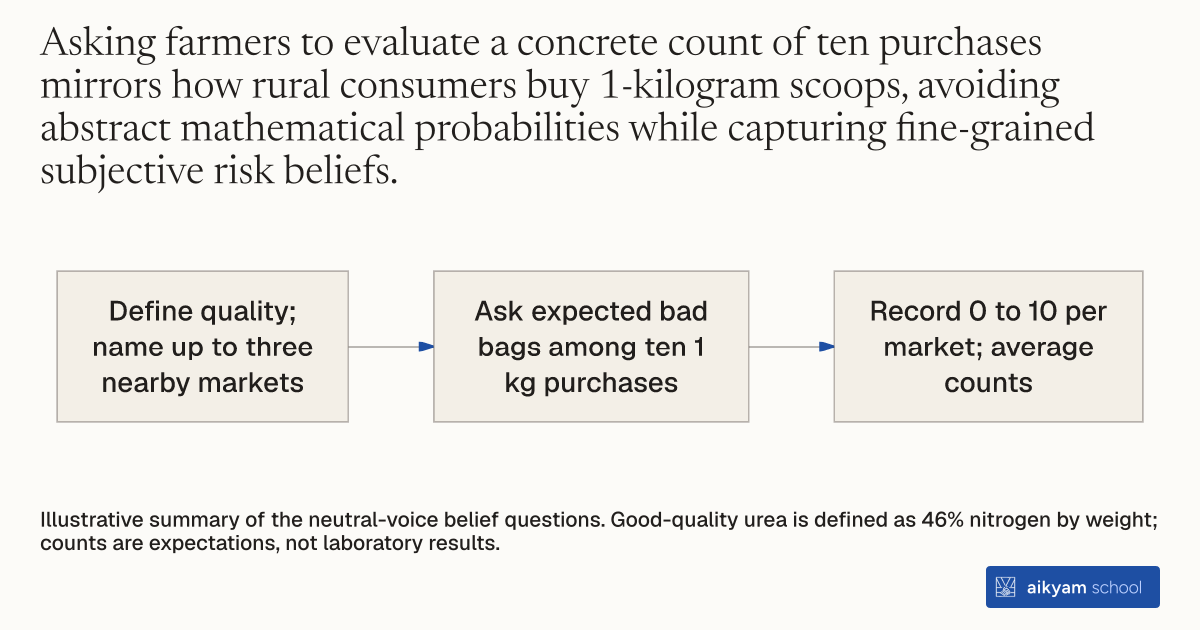
Research procedure
Elicit expected bad fertilizer bags
- Define quality; name up to three nearby markets
- Ask expected bad bags among ten 1 kg purchases
- Record 0 to 10 per market; average counts
Illustrative summary of the neutral-voice belief questions. Good-quality urea is defined as 46% nitrogen by weight; counts are expectations, not laboratory results.
See source →How
When to use
Smallholder farmers hold complex, subjective quality expectations about agricultural inputs that cannot be captured by simple binary yes/no survey questions. Standard mathematical probability questions confuse respondents during field interviews. Evaluators use this method to measure consumer quality perceptions in rural populations using concrete frequency counts.
Measure subjective beliefs about input quality by asking farmers how many 1-kilogram packages out of ten hypothetical purchases would be bad quality.
- Train enumerators to ask belief elicitation questions in a neutral voice to prevent surveyor knowledge from spilling over to respondents.
- Define good quality explicitly to the respondent before asking questions, explaining that good quality urea contains 46% nitrogen by weight.
- Select up to three specific local markets near the respondent's village, including the primary associated market.
- Present a concrete scenario asking how many bags out of ten purchased by ten farmers at a named market would be bad quality.
- Record the numeric count of expected bad quality bags from zero to ten for each market individually.
- Calculate the respondent's average expected bad bag count across markets to construct a continuous measure of quality suspicion.
Example
Enumerators used this 10-bag count method to elicit baseline and endline fertiliser quality beliefs from 1,479 farmers across 148 villages in Morogoro Region, Tanzania. At baseline, farmers reported an average of 2 bad bags out of 10, with 77% expressing quality concerns; post-intervention, the average expected bad bag count dropped by 0.595 bags.
About the study
Participants
N = 995 farmers in a balanced panel across 148 villages in Morogoro Region, Tanzania.
Study Design
Panel survey ANCOVA estimation measuring subjective beliefs across three proximate markets using a probability-framed 10-bag count elicitation formulation.
Results
The village information intervention reduced the average expected bad quality bag count by 0.595 (a 30% reduction, p < 0.01) and reduced the probability of having any quality concern by 10.5 percentage points (a 12% reduction, p < 0.05).