Research steps
Compare training costs and returns
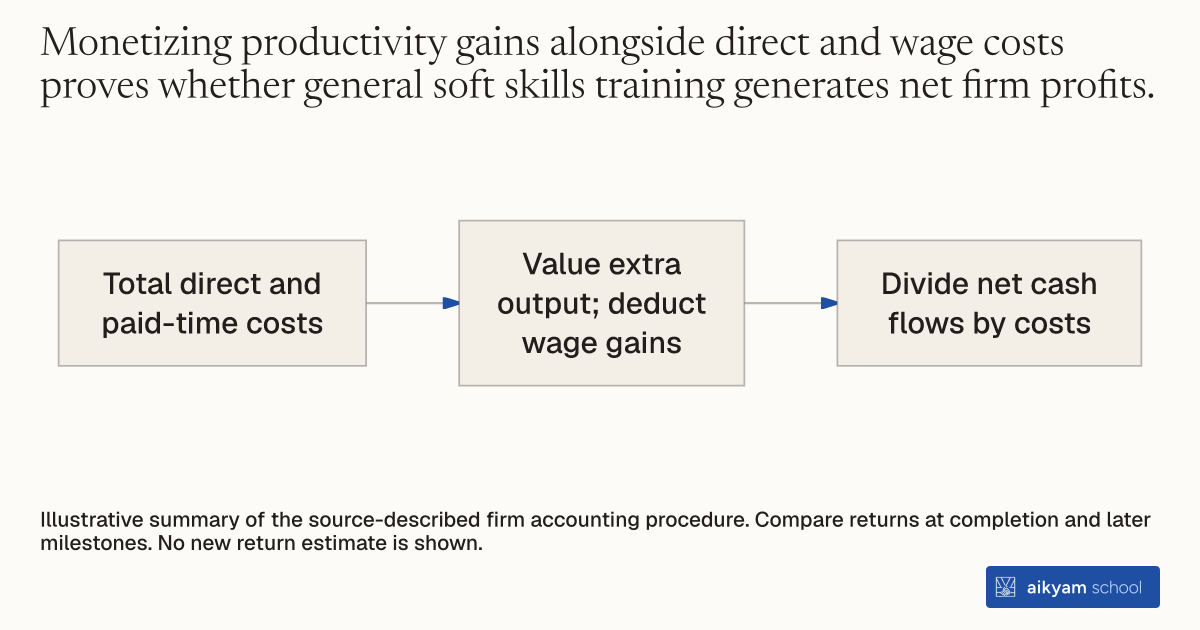
- Total direct and paid-time costs
- Value extra output; deduct wage gains
- Divide net cash flows by costs
Illustrative summary of the source-described firm accounting procedure. Compare returns at completion and later milestones. No new return estimate is shown.
See source →How
When to use
Firms hesitate to fund soft skills training for low-wage workers because they lack methods to measure whether efficiency gains outweigh direct instruction costs. Unclear return estimates lead corporate decision makers to view workforce development as an expense rather than a profitable investment. Calculate net present value and financial return on investment by monetizing production gains and accounting for training costs.
Calculate program net present value and financial return on investment by comparing direct and indirect operational training costs against accumulated net revenue gains from worker productivity.
- Sum all direct training expenses, including curriculum materials, equipment, and trainer salaries across participating factories.
- Calculate indirect opportunity costs by multiplying worker hourly wage rates by total classroom hours conducted during paid production time.
- Measure physical production increases by recording daily worker garment output against industrial engineering operation benchmarks.
- Monetize physical output gains by multiplying extra completed garments by the firm's marginal profit per garment.
- Subtract total wage increases paid to treated workers from gross revenue gains to isolate net firm cash flows.
- Divide cumulative net firm cash flows by total program costs to calculate accounting return on investment at program completion and post-completion milestones.
Why it works
Accounting for persistent output gains reveals that returns accumulate over time as workers apply learned skills without substantial wage increases.
Example
An export garment firm in Bengaluru, India spent \$95,000 to train 1,087 female sewing operators across five factories in the P.A.C.E. program, covering trainer salaries, materials, and paid class time. The intervention generated a 10.8 percentage point increase in worker efficiency while increasing monthly wages by only 0.5 percent, yielding a 73 percent net return at program completion and a 258 percent net return eight months later.
About the study
Participants
2,703 female garment workers across 112 production lines in 5 export factories in Bengaluru, India (1,087 trained workers).
Study Design
Two-stage randomized controlled trial calculating net accounting returns by comparing total direct and indirect training costs (\$95,000) against monetized net production gains derived from tablet efficiency tracking over 20 months.
Results
Total program costs equaled \$87.39 per worker (\$95,000 total across 1,087 workers), producing a net return on investment to the firm of 73 percent at program completion and 258 percent eight months post-completion.