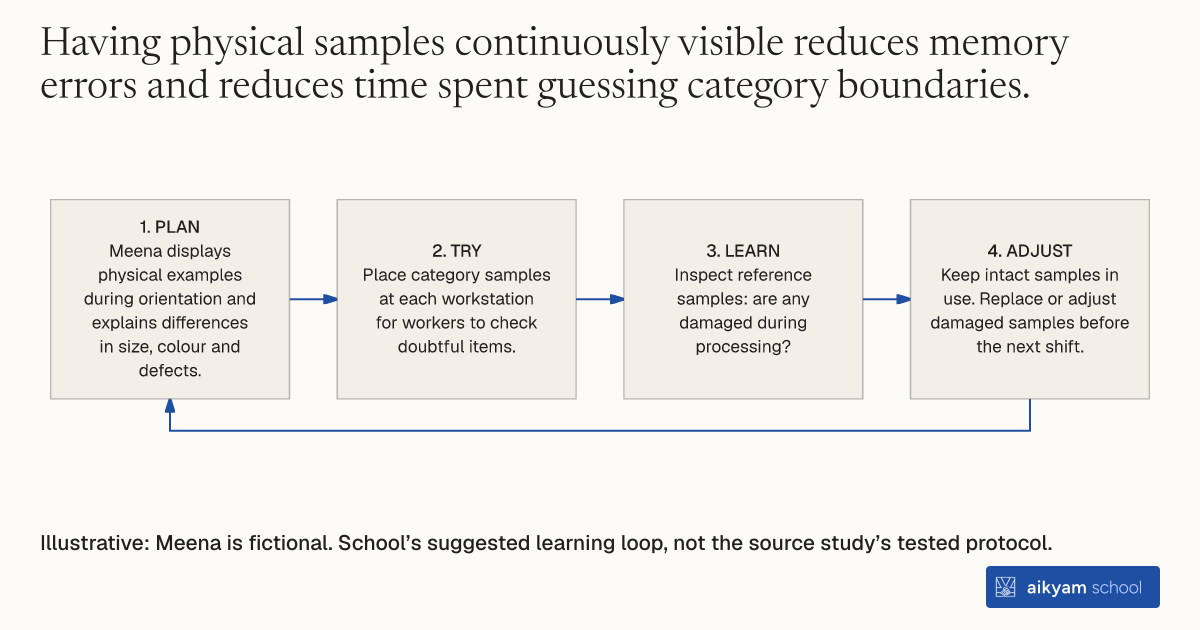
Try, learn and adjust
Check physical sorting references
- Plan: Meena displays physical examples during orientation and explains differences in size, colour and defects.
- Try: Place category samples at each workstation for workers to check doubtful items.
- Learn: Inspect reference samples: are any damaged during processing?
- Adjust: Keep intact samples in use. Replace or adjust damaged samples before the next shift.
Illustrative: Meena is fictional. School’s suggested learning loop, not the source study’s tested protocol.
See source →School’s suggested learning loop checks the condition of reference samples, separately from the study’s provision of visual aids.
How
When to use
When casual laborers perform multi-category sorting tasks, oral instructions alone can lead to confusion over classification boundaries. Providing physical visual reference samples gives workers constant clarity on quality standards throughout their work shift. This method helps field managers supervising manual sorting or processing operations.
Provide workers with physical visual reference samples at their workstations to maintain sorting accuracy across categories.
- Display physical examples of each sorted output category at the front of the training area during initial orientation.
- Walk participants through each category sample to explain visual differences in size, color, and defect types.
- Place visual reference aids containing physical samples of each sorted category at every individual workstation.
- Instruct workers to compare questionable items against the reference samples throughout their sorting shift.
- Replenish or adjust reference samples if damaged during processing.
Why it works
Workers can quickly verify ambiguous items against concrete physical benchmarks without interrupting supervisors.
Example
Field researchers in rural Malawi provided visual reference samples of eight bean categories to 689 casual workers sorting mixed beans. Workers consulted these physical samples at their workstations across four workdays, keeping sorting errors relatively low across 1,461 daily contract sessions.
About the study
Participants
612 contracted workers across 1,461 worker-day observations in 12 villages in rural Malawi (66.5% female, mean age 34.9 years).
Study Design
Randomized field experiment where all workers received visual aids and physical category examples during training and at individual sorting stations across four consecutive days.
Results
Workers maintained an average quality score of 1.88 errors per unit, with errors decreasing from 2.20 on Day 1 to 1.69 on Day 4 (p < 0.01) as familiarity with reference standards increased.