Try, learn and adjust
Check piece-rate payments at shift end
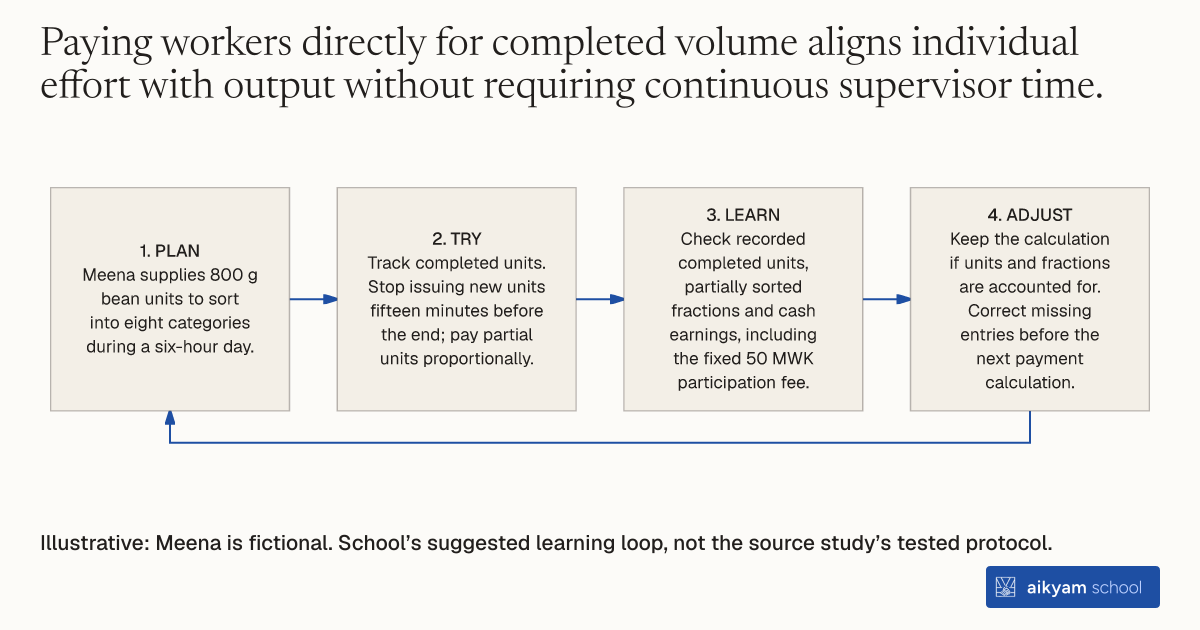
- Plan: Meena supplies 800 g bean units to sort into eight categories during a six-hour day.
- Try: Track completed units. Stop issuing new units fifteen minutes before the end; pay partial units proportionally.
- Learn: Check recorded completed units, partially sorted fractions and cash earnings, including the fixed 50 MWK participation fee.
- Adjust: Keep the calculation if units and fractions are accounted for. Correct missing entries before the next payment calculation.
Illustrative: Meena is fictional. School’s suggested learning loop, not the source study’s tested protocol.
See source →School’s suggested learning loop checks unit records and payment calculations, separately from the tested contract.
How
When to use
Rural agricultural employers often need to hire casual daily laborers to process harvested crops into higher-value sorted goods. Setting fixed daily wages fails to motivate rapid task completion when direct oversight is difficult. Structuring daily piece-rate contracts by unit volume allows employers to pay directly for output produced during six-hour daily shifts.
Structure casual daily piece-rate contracts for agricultural sorting tasks to compensate workers directly per volume unit produced.
- Provide each hired worker with standardized 800 g units of unsorted mixed beans at a dedicated workstation.
- Direct workers to sort the mixed beans into eight specified categories during a six-hour workday.
- Track completed 800 g units as workers present them to site supervisors throughout the shift.
- Stop handing out new unsorted bean units fifteen minutes before the end of the six-hour workday.
- Calculate proportional payments for partially completed units at the end of the shift based on the fraction sorted.
- Pay workers their total accumulated piece-rate earnings in cash alongside a fixed 50 MWK daily participation fee.
Why it works
Allowing proportional pay for partially sorted units at shift end prevents disputes and rewards late-shift labor effort.
Example
Field researchers hired 612 casual day laborers across 12 villages in rural Malawi to sort mixed dried beans into eight categories over six-hour daily contracts. Workers received piece rates ranging from 5 to 25 MWK per 800 g unit plus a 50 MWK daily participation fee, completing an average of 7.35 units per day and earning over 170 MWK daily.
About the study
Participants
612 contracted workers across 1,461 worker-day observations in 12 villages in rural Malawi (66.5% female, mean age 34.9 years).
Study Design
Field experiment offering randomized piece-rate contracts (5, 10, 15, 20, or 25 MWK per 800 g unit sorted) across four consecutive six-hour workdays per village.
Results
Workers sorted an average of 7.35 units per six-hour workday, with daily output increasing from 6.02 units on Day 1 to 8.12 units on Day 4 (p < 0.01), generating average daily piece-rate earnings above 120 MWK plus participation pay.