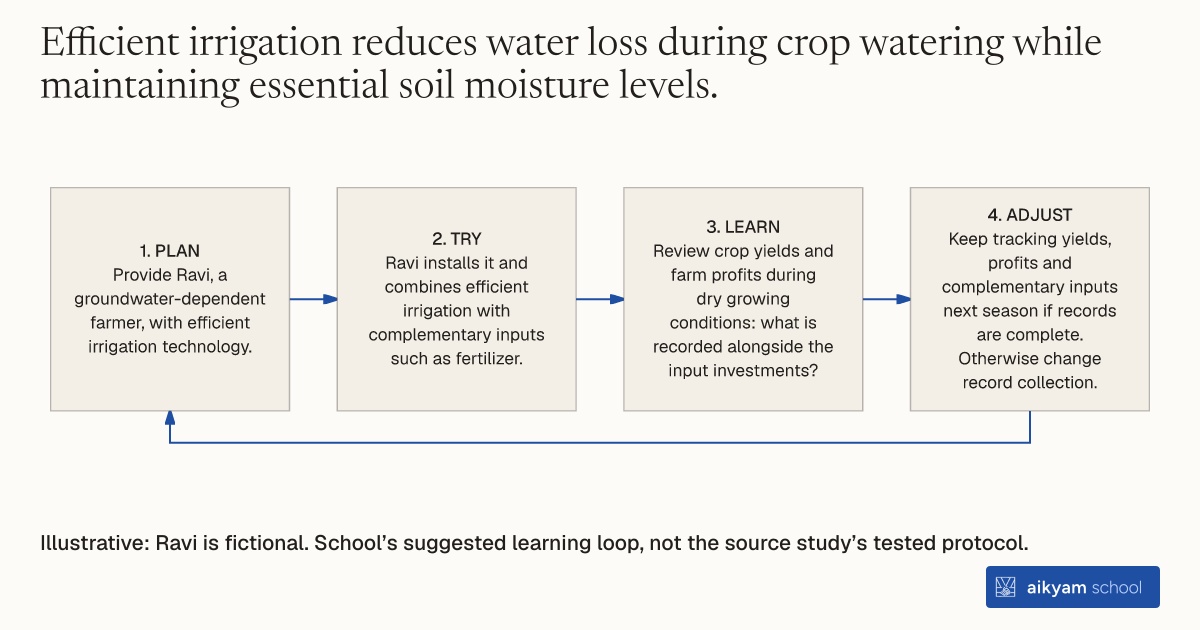
Try, learn and adjust
Check irrigation alongside yields and farm profits
- Plan: Provide Ravi, a groundwater-dependent farmer, with efficient irrigation technology.
- Try: Ravi installs it and combines efficient irrigation with complementary inputs such as fertilizer.
- Learn: Review crop yields and farm profits during dry growing conditions: what is recorded alongside the input investments?
- Adjust: Keep tracking yields, profits and complementary inputs next season if records are complete. Otherwise change record collection.
Illustrative: Ravi is fictional. School’s suggested learning loop, not the source study’s tested protocol.
See source →School’s suggested, untested loop. Observe yields, profits and complementary inputs; do not infer groundwater conservation from these measures alone.
How
When to use
Water scarcity and groundwater depletion threaten agricultural production in drought-prone farming regions. Providing efficient irrigation technologies helps smallholder farmers maintain crop production while conserving water resources. It targets smallholder farmers reliant on groundwater in drought-vulnerable agricultural areas.
Provide efficient irrigation technologies to smallholder farmers to maintain crop yields and agricultural profitability.
- Extension services and development programs distribute efficient irrigation technologies to groundwater-dependent smallholder farmers.
- Farmers install efficient irrigation systems on cultivated agricultural fields.
- Farmers combine efficient irrigation practices with complementary agricultural inputs like fertilizers.
- Farmers irrigate crops efficiently to maintain agricultural yields and generate farm profits during water-scarce seasons.
Why it works
Combining efficient irrigation with complementary inputs allows farmers to sustain higher crop yields and farm profitability without over-extracting groundwater reserves.
Example
In South India, researchers evaluated farmers adopting efficient irrigation technologies in groundwater-dependent agricultural settings. Adopting efficient irrigation alongside complementary agricultural inputs enabled smallholder farmers to maintain or increase crop yields and sustain agricultural profits during dry growing conditions.
About the study
Participants
Smallholder farmers reliant on groundwater irrigation in South India.
Study Design
Randomized evaluation / quasi-experimental study assessing efficient irrigation technology adoption, crop yields, and profitability.
Results
Efficient irrigation technologies enabled smallholder farmers to maintain or increase crop yields and maintain or increase agricultural profitability when adopted alongside complementary input investments.