Research steps
Provide working phones for repeated surveys
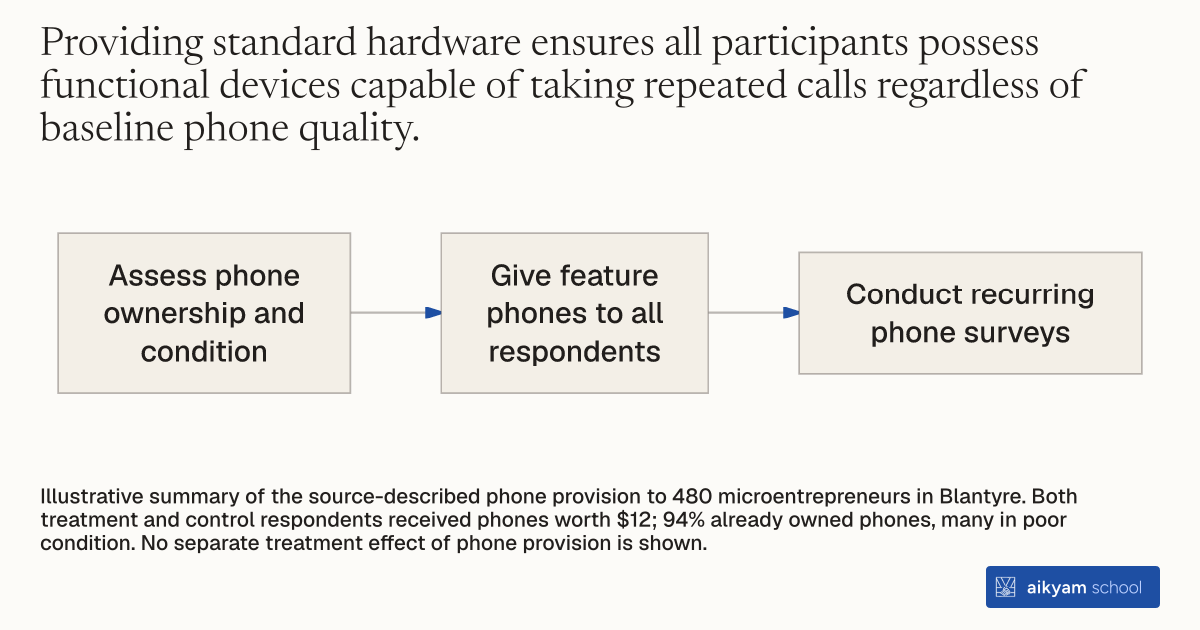
- Assess phone ownership and condition
- Give feature phones to all respondents
- Conduct recurring phone surveys
Illustrative summary of the source-described phone provision to 480 microentrepreneurs in Blantyre. Both treatment and control respondents received phones worth $12; 94% already owned phones, many in poor condition. No separate treatment effect of phone provision is shown.
See source →How
When to use
In longitudinal research programs, evaluators need to collect high-frequency data from urban microentrepreneurs via phone surveys. Poor device condition and broken hardware create non-response bias and high attrition during remote monitoring. Distributing working feature phones removes equipment constraints and enables reliable survey participation.
Distribute standard feature phones to study participants to enable consistent mobile survey data collection.
- Enumerators assess baseline mobile phone ownership and physical hardware condition among business owners.
- Field staff procure basic feature phones valued at $12 per device.
- Distribute feature phones to all study respondents across treatment and control groups.
- Instruct participants to maintain phone charge and active network connectivity for scheduled survey calls.
- Project enumerators execute recurring high-frequency phone surveys using the distributed devices.
Why it works
Eliminating hardware barriers prevents survey dropouts and allows researchers to gather reliable panel data.
Example
Researchers provided $12 feature phones to 480 microentrepreneurs in Blantyre, Malawi, where 94% owned cell phones but many devices were damaged, successfully enabling multi-round high-frequency phone surveys.
About the study
Participants
480 microentrepreneurs in Blantyre, Malawi.
Study Design
Randomized controlled trial providing $12 feature phones to all respondents to facilitate mobile phone survey data collection.
Results
Feature phone provision overcame device damage barriers among 94% baseline phone owners, enabling 2,721 high-frequency survey responses across 232 businesses and 786 monitoring survey responses across 429 businesses.