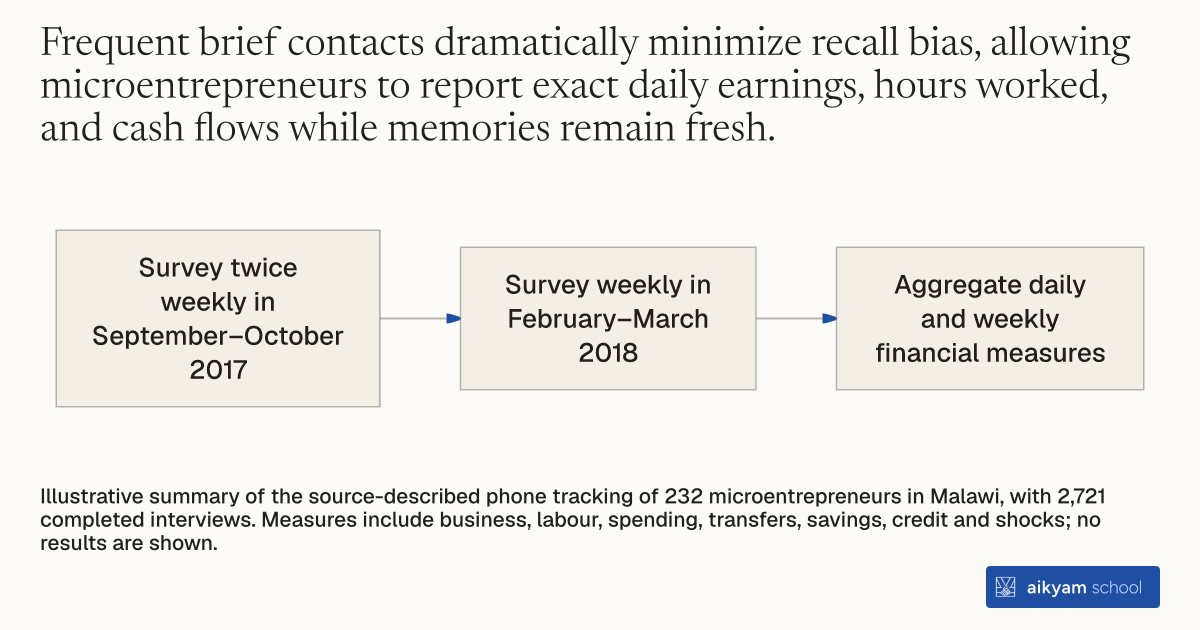
Research procedure
Track short-period financial outcomes
- Survey twice weekly in September–October 2017
- Survey weekly in February–March 2018
- Aggregate daily and weekly financial measures
Illustrative summary of the source-described phone tracking of 232 microentrepreneurs in Malawi, with 2,721 completed interviews. Measures include business, labour, spending, transfers, savings, credit and shocks; no results are shown.
See source →How
When to use
Program evaluators need to track volatile economic behaviors and short-term shocks among urban microentrepreneurs. Standard long-recall surveys suffer from memory bias when recording daily business profits, labor allocation, or fluid cash transactions. Executing repeated high-frequency phone surveys captures detailed daily and weekly financial dynamics without relying on long retrospective recall.
Track participant financial behavior and labor decisions by administering high-frequency phone surveys across multiple survey rounds.
- Enumerators select half of the study sample (232 microentrepreneurs) to participate in high-frequency monitoring.
- Conduct Round 1 phone surveys twice per week during September and October 2017.
- Conduct Round 2 phone surveys once per week during February and March 2018.
- Measure short-period business outcomes, labor supply, daily expenditures, interpersonal transfers, savings, credit, and unexpected shocks.
- Aggregate survey responses across 2,721 total completed interviews to calculate standardized daily averages.
Why it works
Repeated sampling over multiple seasons captures short-term fluctuations and seasonal behavioral shifts that annual or baseline surveys miss.
Example
In Blantyre, Malawi, enumerators conducted 2,721 high-frequency phone interviews across 232 microentrepreneurs in two multi-week rounds, capturing a significant reallocation of labor from primary business to farming.
About the study
Participants
232 microentrepreneurs (subsample of 480) in Blantyre, Malawi.
Study Design
Randomized controlled trial collecting high-frequency phone survey panel data (twice weekly in Round 1, once weekly in Round 2) totaling 2,721 completed observations.
Results
High-frequency tracking revealed that mobile money provision reduced primary business work probability by 7 percentage points (p < 0.05) and increased farming work by 0.23 days per week (p < 0.05).