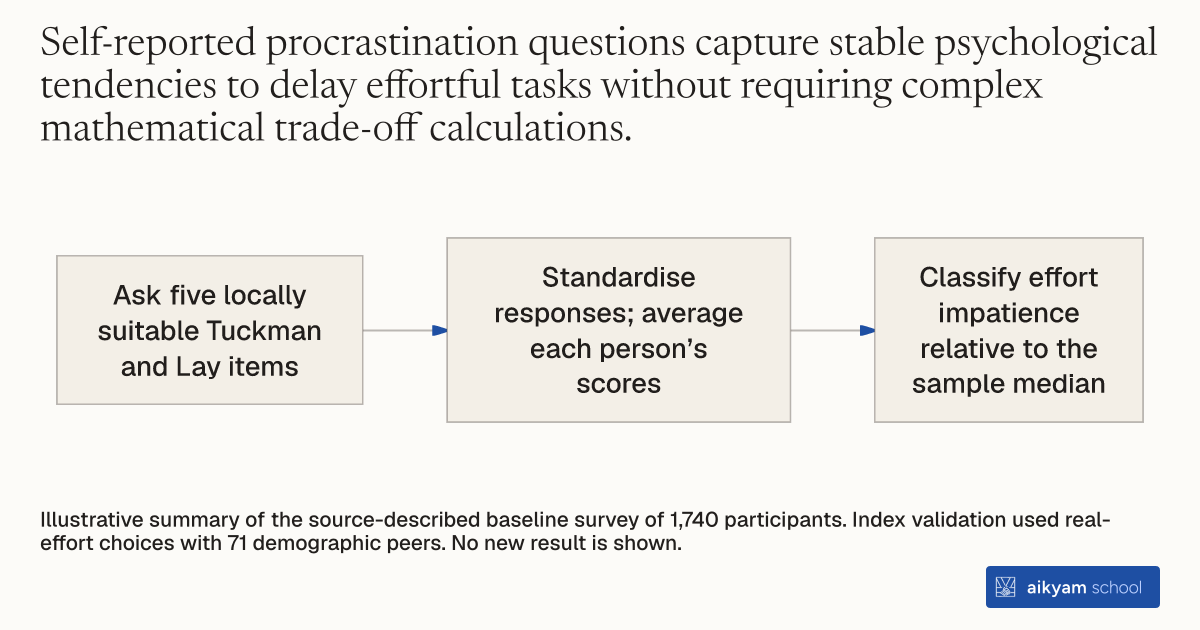
Research steps
Build a procrastination index
- Ask five locally suitable Tuckman and Lay items
- Standardise responses; average each person’s scores
- Classify effort impatience relative to the sample median
Illustrative summary of the source-described baseline survey of 1,740 participants. Index validation used real-effort choices with 71 demographic peers. No new result is shown.
See source →How
When to use
Behavioral interventions need to identify individuals with high effort procrastination to diagnose self-control bottlenecks and tailor contract structures. Traditional laboratory incentivized preference measures often fail or suffer from high error rates when administered to populations with limited formal education. This method serves health and development projects evaluating participant impatience in field settings.
Administer a concise psychometric survey using validated procrastination Likert scales to quantify present bias over effort.
- Select a subset of items from validated psychological procrastination scales, such as the Tuckman and Lay scales, that translate cleanly to the local cultural setting.
- Present survey statements to participants, including items like "I'm always saying: I'll do it tomorrow" and "I postpone starting on things I dislike to do."
- Ask participants to rate their level of agreement with each statement using a standard Likert scale during baseline field interviews.
- Normalize the individual numerical responses to each survey item by subtracting the sample mean and dividing by the standard deviation.
- Average the standardized responses across all items for each participant to construct a composite impatience index.
- Classify participants relative to the sample median score to identify groups with high versus low effort impatience.
Why it works
The composite index mitigates measurement noise and strongly correlates with incentivized real-effort choices in field environments.
Example
Surveyors administered a 5-item procrastination survey to 1,740 adults with diabetes or high blood sugar in Coimbatore, India. Participants with an above-median impatience index allocated 1.3 more effort tasks to future dates than today in an incentivized task, compared to 0.4 tasks among those with below-median impatience.
About the study
Participants
1,740 trial participants in Coimbatore, India, with an average age of 49.56 years, 42 percent female, 67 percent diagnosed diabetic, and a validation sample of 71 demographic peers.
Study Design
Surveyors conducted baseline psychometric interviews using 5 Tuckman and Lay scale items, validating the resulting index against incentivized real-effort task choices (calling automated phone lines at varying piece rates) and baseline walking levels.
Results
A one standard deviation increase in the impatience index reduced baseline daily walking and increased the compliance advantage of time-bundled threshold contracts over linear contracts by 4 percentage points (6.5 percentage points for above-median impatience).