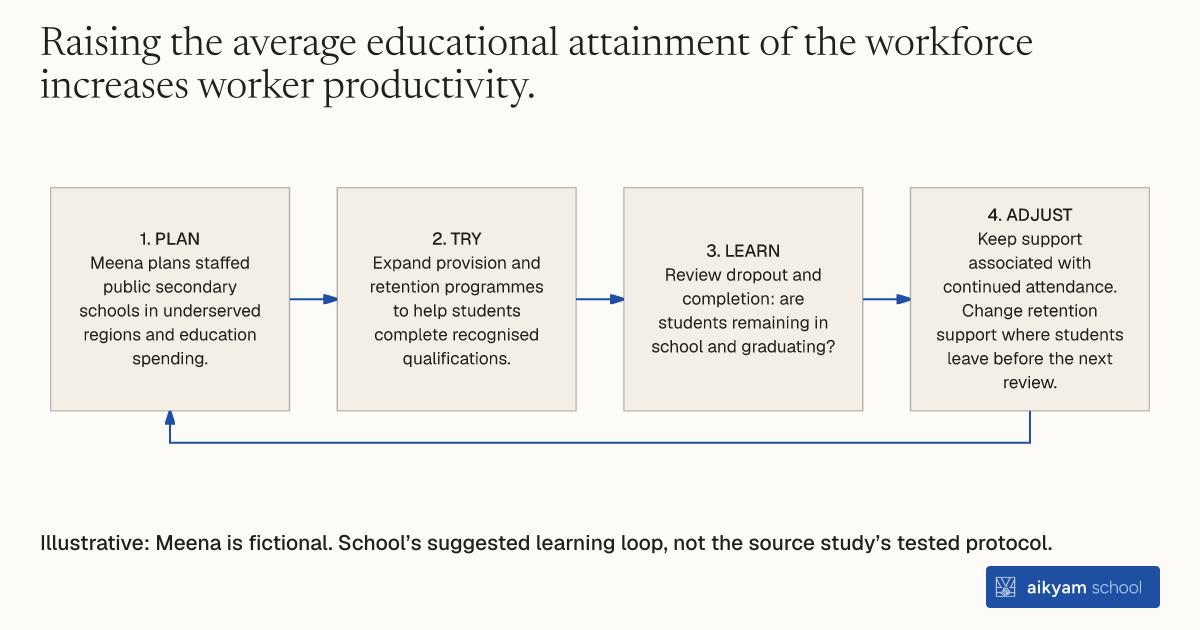
Try, learn and adjust
Check school expansion supports student completion
- Plan: Meena plans staffed public secondary schools in underserved regions and education spending.
- Try: Expand provision and retention programmes to help students complete recognised qualifications.
- Learn: Review dropout and completion: are students remaining in school and graduating?
- Adjust: Keep support associated with continued attendance. Change retention support where students leave before the next review.
Illustrative: Meena is fictional. School’s suggested learning loop, not the source study’s tested protocol.
See source →Observe dropout, completion and recognised qualifications; these alone do not establish reduced labour informality. School suggests this learning loop; it is not the source’s tested procedure.
How
When to use
Low workforce education levels limit worker productivity, making formal employment contracts unprofitable for firms and driving workers into informal labor. This situation leaves uneducated workers trapped in low-paying informal jobs without social protection. It applies to national education and labor authorities seeking long-term structural reductions in labor informality.
Expand public secondary and higher education infrastructure to increase workforce educational attainment.
- Build and staff public secondary schools across underserved regions and rural municipalities.
- Increase public expenditure on compulsory primary and secondary education.
- Implement student retention programs to minimize dropout rates among adolescent students.
- Graduate students with recognized academic credentials required by formal employers.
Why it works
Higher skill levels enable workers to qualify for and secure formal jobs that require technical and cognitive competencies.
Example
In Brazil, the expansion of formal schooling between 1990 and 2010 significantly increased workforce qualification, serving as a primary driver of falling labor informality.
Source
See source →Evidence in Labor Market Policies and Implications for Brazil: Informality
Copyright © 2025 Inter-American Development Bank.
Full source notice
Copyright © 2025 Inter-American Development Bank ("IDB"). This work is subject to a Creative Commons license CC BY 3.0 IGO (https://creativecommons.org/licenses/by/3.0/igo/legalcode). The terms and conditions indicated in the URL link must be met and the respective recognition must be granted to the IDB. Further to section 8 of the above license, any mediation relating to disputes arising under such license shall be conducted in accordance with the WIPO Mediation Rules. Any dispute related to the use of the works of the IDB that cannot be settled amicably shall be submitted to arbitration pursuant to the United Nations Commission on International Trade Law (UNCITRAL) rules. The use of the IDB's name for any purpose other than for attribution, and the use of IDB's logo shall be subject to a separate written license agreement between the IDB and the user and is not authorized as part of this license. Note that the URL link includes terms and conditions that are an integral part of this license.