Research steps
Test demand at randomly assigned tutoring prices
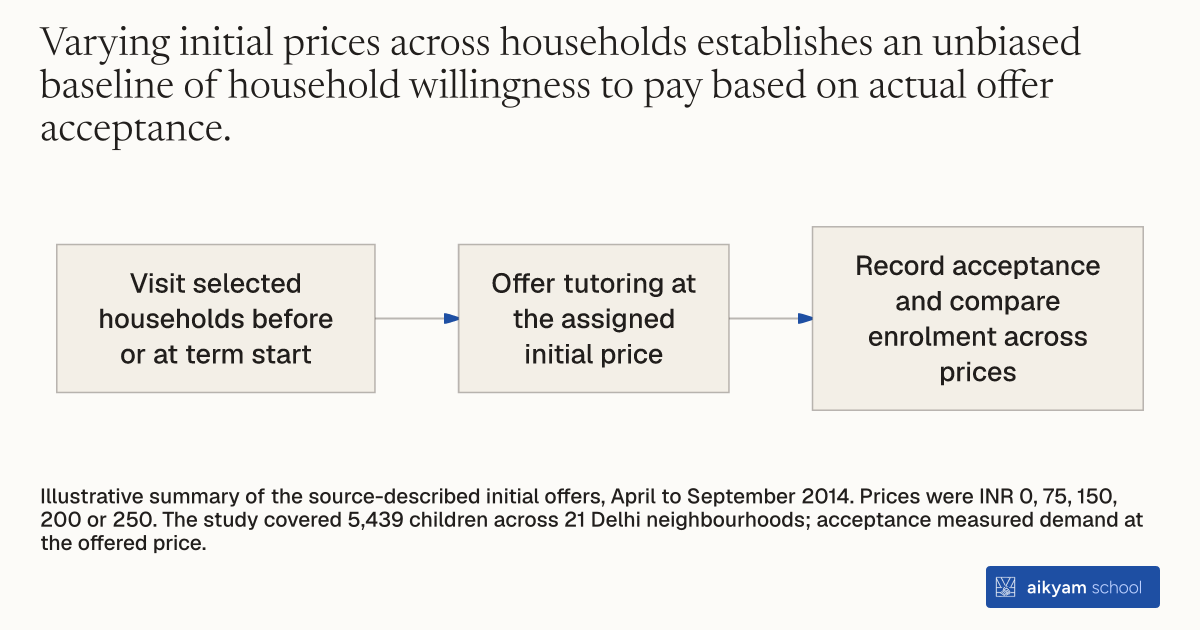
- Visit selected households before or at term start
- Offer tutoring at the assigned initial price
- Record acceptance and compare enrolment across prices
Illustrative summary of the source-described initial offers, April to September 2014. Prices were INR 0, 75, 150, 200 or 250. The study covered 5,439 children across 21 Delhi neighbourhoods; acceptance measured demand at the offered price.
See source →How
When to use
Educational and social service providers in low-income urban areas need to set program fees without knowing how price increases affect take-up. Unplanned fee structures risk pricing out vulnerable families or failing to cover operational costs. Randomizing initial offer prices identifies exact household willingness to pay across low-income target groups.
Offer program services at randomly assigned initial prices to measure household demand and willingness to pay.
- Program staff select target households with upper primary school children in low-income neighborhoods.
- Field recruiters visit each selected household before or at the start of the school term.
- Recruiters offer program enrollment at a randomly assigned initial price ranging from INR 0 to INR 250.
- Staff record whether the household accepts the price offer and registers the child for classes.
- Researchers analyze offer acceptance rates across price tiers to determine household willingness to pay.
Why it works
This allows organizations to measure price sensitivity and predict enrollment at different fee levels.
Example
Pratham offered tutoring to households of 5,439 upper primary school children across 21 low-income neighborhoods in Delhi, India, at randomly assigned prices of INR 0, INR 75, INR 150, INR 200, or INR 250, resulting in 69 percent enrollment at INR 0 and a 17 percentage point drop when charging INR 100.
About the study
Participants
5,439 upper primary school children from 21 low-income neighborhoods in Delhi, India, where 10 percent attended private school and mothers averaged 3.7 years of education.
Study Design
Researchers conducted a randomized evaluation between April and September 2014, offering households randomly assigned initial tutoring prices ranging from INR 0 to INR 250.
Results
Sixty-nine percent of students offered free tutoring enrolled, but charging INR 100 caused enrollment to drop by around 17 percentage points (25 percent).