Research steps
Separate initial prices from later discounts
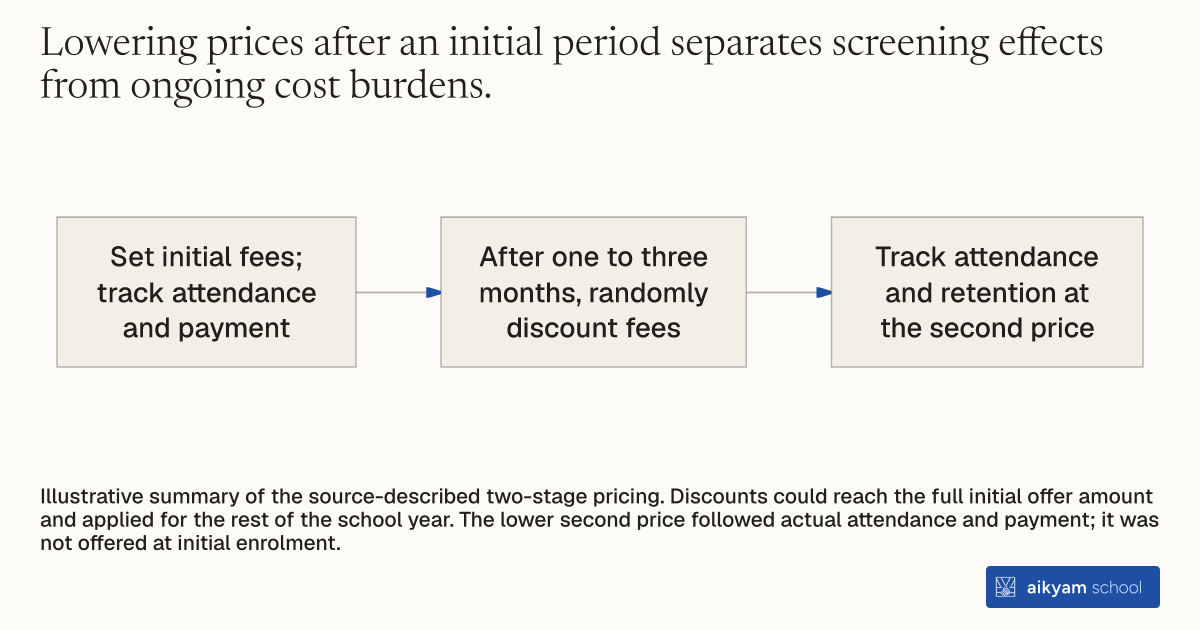
- Set initial fees; track attendance and payment
- After one to three months, randomly discount fees
- Track attendance and retention at the second price
Illustrative summary of the source-described two-stage pricing. Discounts could reach the full initial offer amount and applied for the rest of the school year. The lower second price followed actual attendance and payment; it was not offered at initial enrolment.
See source →How
When to use
Social service providers and tutoring programs struggle to separate price screening from ongoing fee burdens. High recurring fees cause participants to weigh costs and drop out over time. Offering a randomized price discount after an initial attendance period isolates whether fees screen for motivation or cause dropouts.
Offer participants a randomized fee discount after an initial payment period to evaluate price sensitivity and improve retention.
- Program managers set initial enrollment prices for households at the start of the term.
- Staff track student attendance and payment during the first one to three months.
- Field staff offer households a randomly assigned discount up to the full initial offer amount.
- Managers record student attendance and retention under the lower second price for the rest of the school year.
Why it works
This allows organizations to test if lower ongoing prices prevent dropouts while retaining motivated students.
Example
Pratham enrolled upper primary school students in Delhi at initial prices between INR 0 and INR 250, then offered randomized discounts after one to three months for the rest of the school year.
About the study
Participants
5,439 upper primary school children from 21 low-income neighborhoods in Delhi, India, where 10 percent attended private school and mothers averaged 3.7 years of education.
Study Design
Researchers conducted a two-stage randomized evaluation where households received initial tutoring prices for one to three months followed by a randomly assigned discount up to the initial price.
Results
Students offered higher initial prices attended more classes by 6 percentage points, but were 12 percentage points more likely to drop out after two to three months.