Research steps
Interview spouses privately
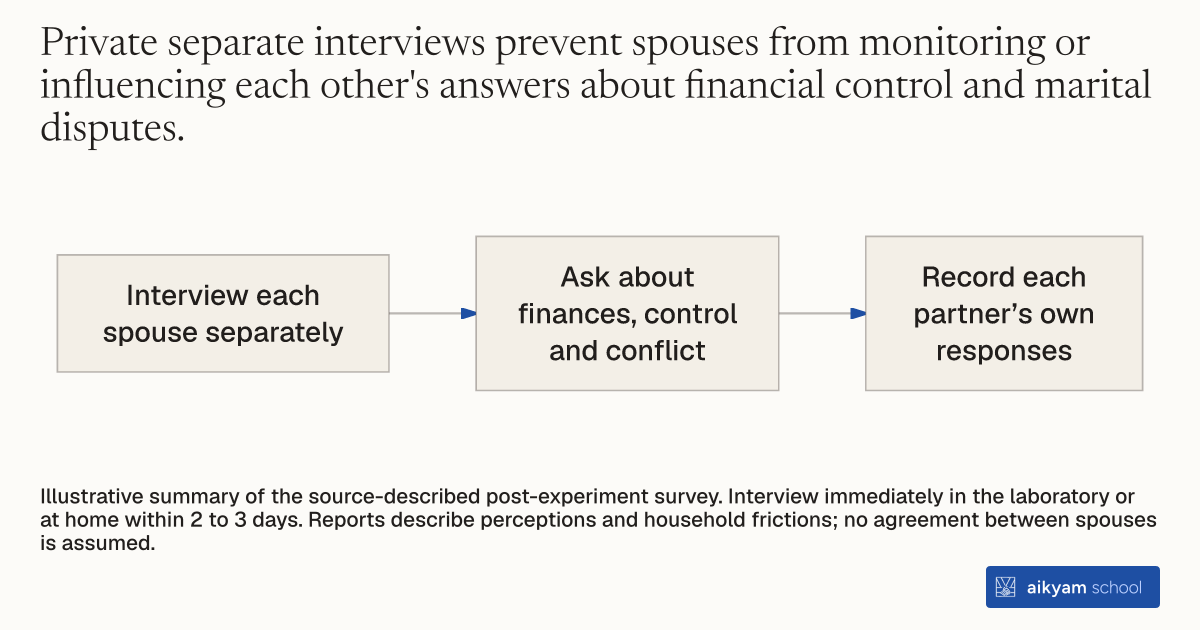
- Interview each spouse separately
- Ask about finances, control and conflict
- Record each partner’s own responses
Illustrative summary of the source-described post-experiment survey. Interview immediately in the laboratory or at home within 2 to 3 days. Reports describe perceptions and household frictions; no agreement between spouses is assumed.
See source →How
When to use
In intra-household research, joint interviews with married couples often cause self-censorship and underreporting of financial conflict. Gathering spousal data together hides private disagreements and individual financial habits. Conducting individual interviews with each spouse separately allows researchers to collect uninfluenced data on financial decision-making power and marital conflict.
Administer individual questionnaires to husbands and wives separately and privately to diagnose household financial control and conflict.
- Local surveyors interview each spouse separately and privately in the laboratory immediately after the experiment or at home within two to three days.
- Surveyors ask each partner about their education level, occupation, daily wage, income variability, and financial account status.
- Surveyors collect detailed reports on how income is received, budget allocation procedures, and how much income is turned over to the spouse.
- Surveyors ask each spouse who controls saving and spending decisions to capture subjective perceptions of financial management.
- Surveyors record individual ratings of spousal patience, impulsiveness, and responsibility alongside reports of money-related marital conflict.
- Surveyors gather data on specific intra-household frictions, including spousal problems with gambling and liquor.
Why it works
Collecting independent reports from both partners reveals intra-household information asymmetries and misalignments in decision-making power.
Example
Researchers surveyed 145 married couples in Mindanao, Philippines, separately and privately following an experimental session. They found that wives managed the household budget in 80 percent of couples, while 36 percent of husbands and 39 percent of wives reported having conflict over money issues.
About the study
Participants
145 married couples (291 individuals) recruited near Green Bank in Mindanao, Philippines, with average age of 43 and 19 years married.
Study Design
Separate private post-experiment surveys administered to husbands and wives individually in the laboratory or at home within two to three days.
Results
80 percent of households reported that the wife does the budgeting; 25 percent reported the wife controls savings decisions and 18 percent reported the husband controls savings decisions; 36 percent of men and 39 percent of women reported conflict over money.