Research procedure
Include unpaid labour in farm costs
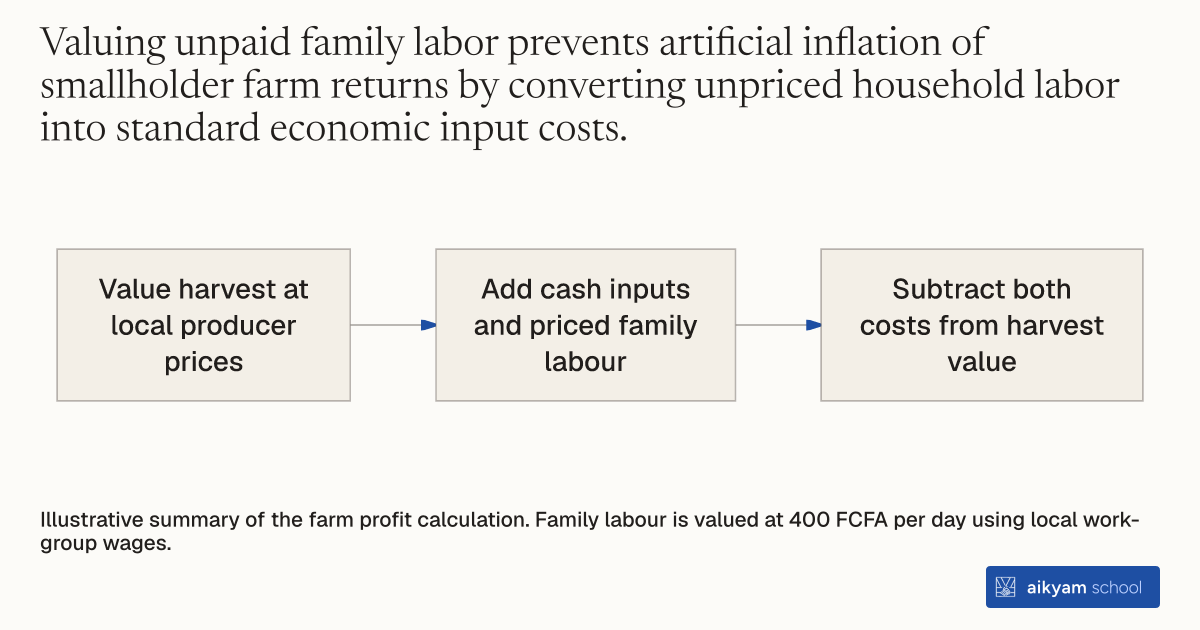
- Value harvest at local producer prices
- Add cash inputs and priced family labour
- Subtract both costs from harvest value
Illustrative summary of the farm profit calculation. Family labour is valued at 400 FCFA per day using local work-group wages.
See source →How
When to use
Evaluating agricultural profitability in rural areas often misleads analysts when unpaid family labor is completely omitted from financial calculations. Valuing unpaid labor at local informal market rates establishes realistic economic profit margins for smallholder farms. This method is designed for agricultural economists and project managers assessing farm enterprise returns.
Calculate net agricultural profits by deducting market-based shadow labor costs alongside cash input expenses from total crop revenue.
- Survey local rural labor markets to establish prevailing daily wage rates paid to agricultural work groups.
- Record the total days of unpaid family labor applied to target farm plots during the cultivation season.
- Calculate gross harvest output value by multiplying total harvested crop quantities by local post-harvest producer prices.
- Sum all cash operating expenses, including seed, land preparation, fertilizer, herbicides, and hired labor.
- Multiply total days of unpaid family labor by the local daily work group wage rate to compute total imputed family labor costs.
- Subtract total cash input expenses and imputed family labor costs from gross harvest output value to determine net economic profit.
Why it works
This accounting practice reveals whether agricultural technologies generate true economic profits or merely return low implicit wages.
Example
In southern Mali, research evaluators calculated net rice profits for 378 female farmers by pricing family labor at 400 FCFA per day based on local work group wages, discovering that control group profits averaged -1,221 FCFA when family labor was deducted.
About the study
Participants
383 primary female rice farmers (378 analyzed at endline) across 23 villages in Bougouni district, southern Mali.
Study Design
Economic profit accounting comparing gross revenues minus cash input costs against net economic profits deducting family labor valued at 400 FCFA per day.
Results
In the control group, average net profits excluding family labor were +22,971 FCFA (SD = 28,881 FCFA); deducting family labor at 400 FCFA per day (mean 59.76 days) converted average control profits to -1,221 FCFA (SD = 27,574 FCFA).