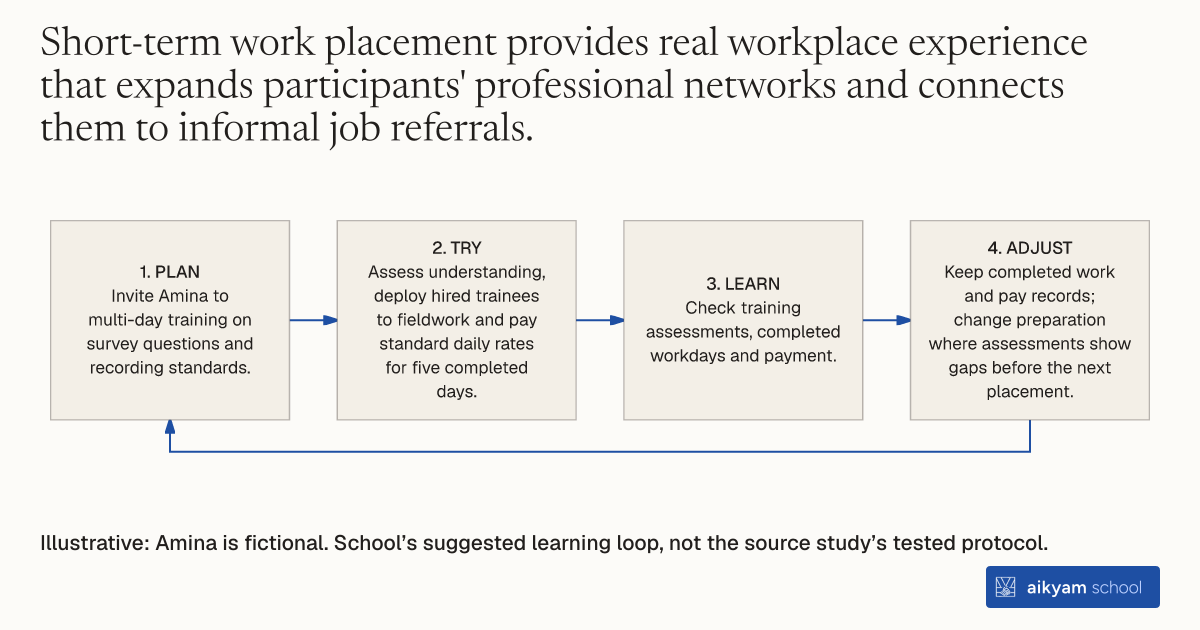
Try, learn and adjust
Check preparation and pay for short-term work
- Plan: Invite Amina to multi-day training on survey questions and recording standards.
- Try: Assess understanding, deploy hired trainees to fieldwork and pay standard daily rates for five completed days.
- Learn: Check training assessments, completed workdays and payment.
- Adjust: Keep completed work and pay records; change preparation where assessments show gaps before the next placement.
Illustrative: Amina is fictional. School’s suggested learning loop, not the source study’s tested protocol.
See source →School’s suggested learning loop: Observe training performance, five-day work completion and pay. This loop does not establish later wage effects.
How
When to use
Active labor market programs aim to improve youth employment outcomes by providing temporary work opportunities. Providing short-term paid contract work allows inexperienced job seekers to gain verified employment history and build professional connections. This method benefits urban youth with secondary education seeking entry-level positions.
Deliver short-term paid contract employment through survey administration tasks.
- Invite selected candidates to participate in an intensive multi-day job training program.
- Train participants on survey questionnaire navigation, item definitions, and recording standards.
- Conduct performance assessments during training to evaluate participant comprehension.
- Deploy hired participants to perform paid fieldwork as survey interviewers or research assistants.
- Remunerate participants at standard daily rates for five completed days of contract work.
Why it works
Working alongside peers and supervisors introduces job seekers to unadvertised employment opportunities.
Example
A recruitment project in Lilongwe, Malawi hired male job seekers for 5 days of paid interviewer and research assistant work at standard daily wages. Participants conducted health survey interviews, qualitative transcriptions, archival research, and data entry.
About the study
Participants
268 male youth job seekers in Lilongwe, Malawi, with 227 re-interviewed at the 9-month follow-up.
Study Design
Randomized Controlled Trial using instrumental variables to estimate 8-month post-intervention daily wages and employment proportions.
Results
5 days of paid work experience increased average post-intervention daily wages by $3.83 to $4.19 per day (p < 0.05), representing an approximate 80% daily wage increase, and increased employment duration by 6.8 to 8.8 percentage points.