Try, learn and adjust
Check household water reports
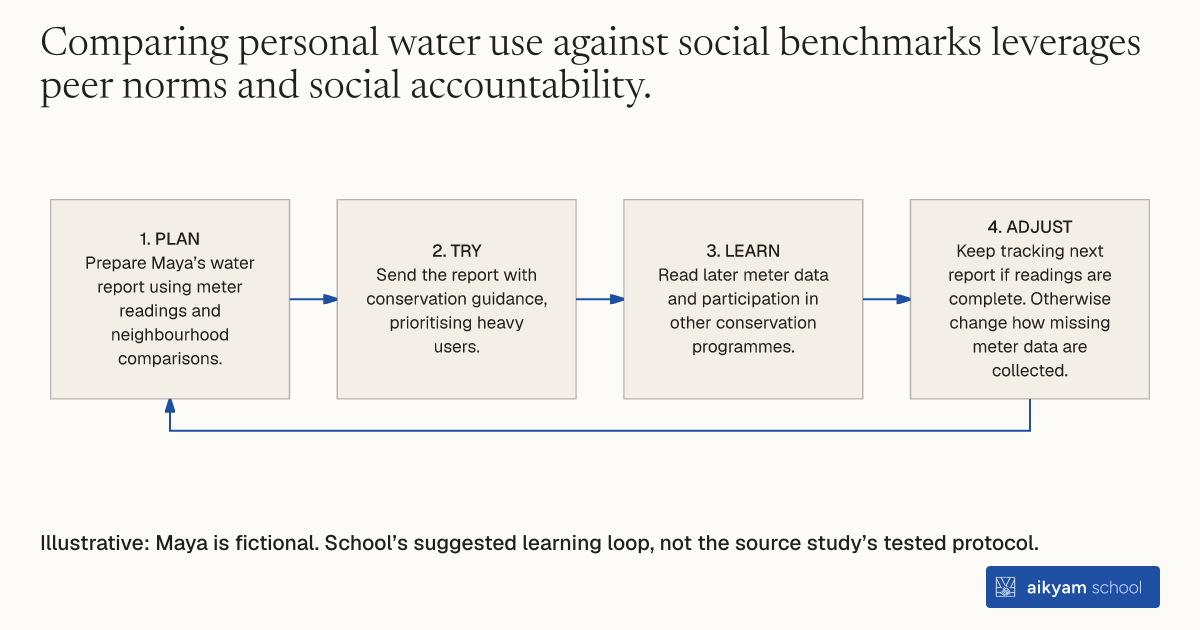
- Plan: Prepare Maya’s water report using meter readings and neighbourhood comparisons.
- Try: Send the report with conservation guidance, prioritising heavy users.
- Learn: Read later meter data and participation in other conservation programmes.
- Adjust: Keep tracking next report if readings are complete. Otherwise change how missing meter data are collected.
Illustrative: Maya is fictional. School’s suggested learning loop, not the source study’s tested protocol.
See source →School’s suggested, untested learning loop. Observe water consumption over time and other conservation enrolment; this loop does not establish impact.
How
When to use
Municipalities face growing water scarcity and high utility treatment costs driven by excess residential consumption. Standard technical advice fails to motivate long-term conservation habits among heavy water users. Delivering home water reports with social comparisons encourages households to reduce consumption.
Send personalized home water reports comparing household consumption against neighboring benchmarks to reduce residential water use.
- Collect residential water meter consumption data across municipal utility billing districts.
- Generate individualized home water reports illustrating household usage alongside average neighborhood benchmarks.
- Include normative prosocial guidance alongside relative consumption graphics to reinforce conservation habits.
- Mail or digitally deliver periodic water reports to target residential utility customers, prioritizing heavy water consumers.
- Track post-report water meter readings to evaluate immediate and long-term consumption reductions.
- Measure customer cross-enrollment rates in complementary utility energy and water conservation initiatives.
Why it works
Normative feedback makes invisible utility consumption salient, prompting high-volume consumers to eliminate wasteful water habits.
Example
Water utilities in Atlanta, San Francisco, Reno, and Milan issued home water reports featuring neighbor usage comparisons to residential customers. Randomized field evaluations showed that social comparison reports significantly reduced household water consumption over long horizons, while increasing participant enrollment in adjacent conservation programs and lowering electricity usage.
About the study
Participants
Residential water customers, homeowners, and heavy water users in Atlanta, Georgia; San Francisco Bay Area, California; Reno, Nevada; and Milan, Italy.
Study Design
Randomized field experiments and randomized controlled trials evaluating home water report delivery, long-term consumption persistence, and cross-program engagement.
Results
Social comparison reports proved the most effective informational strategy for reducing household water usage, generating long-lasting consumption cuts. High-income households, homeowners, and heavy water users responded most strongly, and report recipients showed higher likelihoods of participating in other conservation programs while reducing electricity consumption.