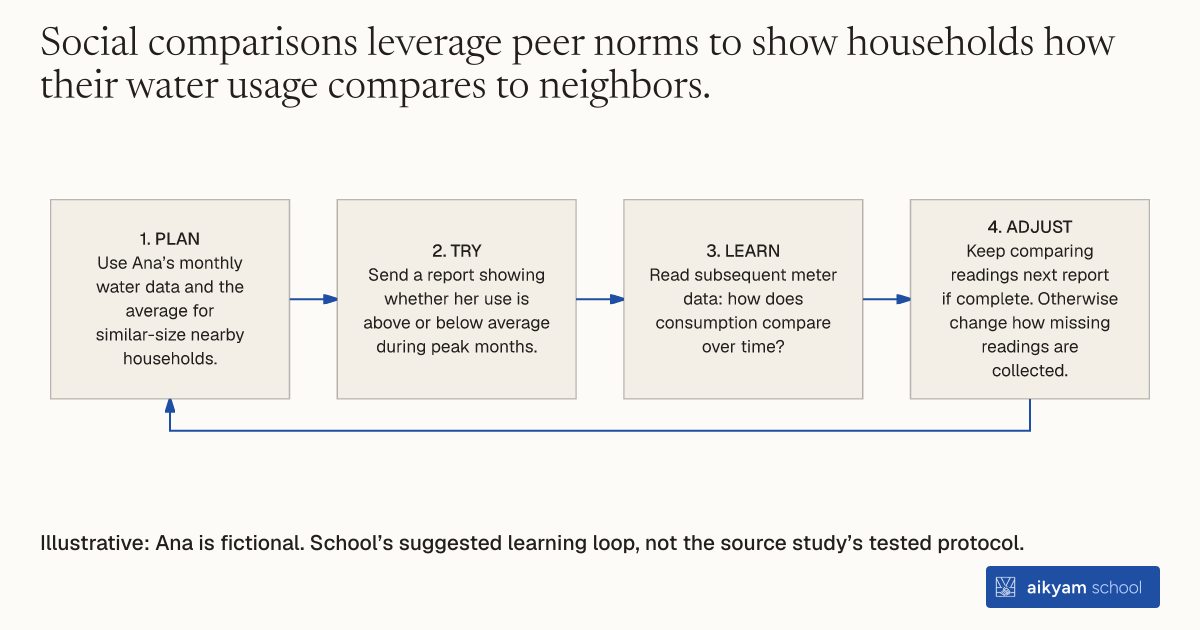
Try, learn and adjust
Check neighbourhood comparisons in water reports
- Plan: Use Ana’s monthly water data and the average for similar-size nearby households.
- Try: Send a report showing whether her use is above or below average during peak months.
- Learn: Read subsequent meter data: how does consumption compare over time?
- Adjust: Keep comparing readings next report if complete. Otherwise change how missing readings are collected.
Illustrative: Ana is fictional. School’s suggested learning loop, not the source study’s tested protocol.
See source →School’s suggested, untested learning loop. Observe household water use and comparison data; this loop does not establish lasting conservation effects.
How
When to use
Technical information alone fails to reduce residential water consumption. Water utilities need low-cost non-financial tools to lower household water demand. This method works for residential utility customers, especially high-volume water consumers.
Send personalized home water reports with social norm comparisons to residential utility customers.
- Water utility staff collect household monthly water meter data across the service area.
- Utility analysts calculate average water consumption for households of similar size in the same neighborhood.
- Designers create home water reports comparing household usage to the neighborhood average.
- Program staff include social comparison graphics showing whether usage is above or below average.
- Mail or email the personalized reports to residential utility customers during peak usage months.
Why it works
Seeing higher relative consumption encourages households to adjust personal habits to match community standards.
Example
A water utility in Cobb County, Georgia sent home water reports with social norm comparisons to residential customers. The prosocial social norm nudges reduced water consumption, maintaining effects for up to six years after the intervention.
About the study
Participants
Residential water utility customers in Cobb County, Georgia.
Study Design
Randomized controlled trial comparing technical advice, prosocial appeals, and social norm peer comparisons.
Results
Social comparison messages produced the largest reductions in household water usage, maintaining statistically detectable conservation impacts up to 6 years post-intervention.