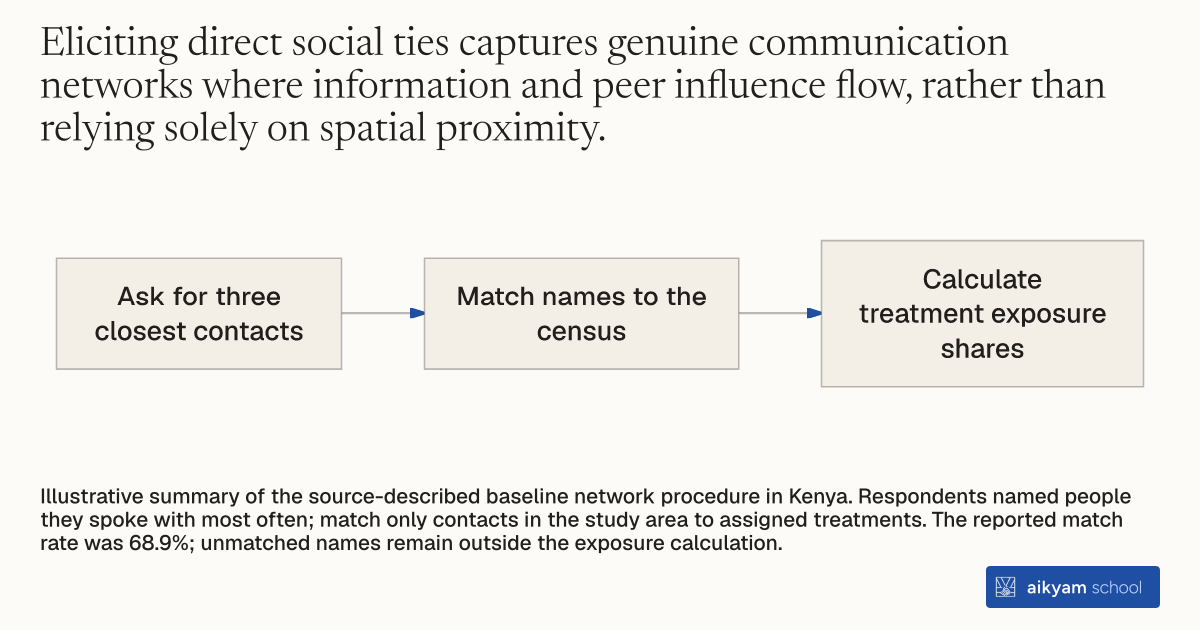
Research procedure
Link named contacts to study assignments
- Ask for three closest contacts
- Match names to the census
- Calculate treatment exposure shares
Illustrative summary of the source-described baseline network procedure in Kenya. Respondents named people they spoke with most often; match only contacts in the study area to assigned treatments. The reported match rate was 68.9%; unmatched names remain outside the exposure calculation.
See source →How
When to use
In development evaluations, interventions can spread through self-reported social networks rather than purely spatial proximity. Use this method when evaluating peer influence, social learning, or information diffusion across close interpersonal relationships. It applies to health programs seeking to identify key social contacts and measure peer spillovers within rural communities.
Elicit close social contacts from survey respondents during baseline interviews and cross-match their names against community census rosters to evaluate social network treatment intensity.
- Field enumerators ask respondents during baseline survey interviews to name the three people they speak with most often in the community.
- Field enumerators collect and record the full names and basic identifying details for each named contact.
- Project managers cross-reference the reported contact names against the complete village door-to-door census list.
- Analysts match each valid contact residing in the study area to their assigned experimental treatment status.
- Researchers calculate the proportion of matched social contacts assigned to each intervention arm to estimate peer spillover effects.
Why it works
Matching contacts to randomized treatments creates exogenous variation in peer exposure, allowing researchers to isolate true social network spillovers.
Example
In Western Kenya, field teams asked 966 survey respondents to name up to three primary contacts, yielding names that were matched to census rosters for 68.9% of contacts. Having a higher proportion of health contacts who received the script produced a slight negative effect on shoe voucher redemption (-7 percentage points, p = 0.083).
About the study
Participants
868 surveyed households with matched social contacts in Busia and Samia Districts of Western Kenya, living on roughly $1 per day.
Study Design
Social network elicitation embedded in baseline surveys, matching named contacts to census rosters and estimating peer spillover effects via OLS regressions conditioned on the number of matched contacts.
Results
68.9% of named contacts were successfully matched to the census list; receiving a low price (<35 Ksh) among matched contacts changed redemption by -1.5 percentage points (p > 0.10), while receiving the script changed redemption by -7 percentage points (p = 0.083).