Research steps
Set up separate administrative batches
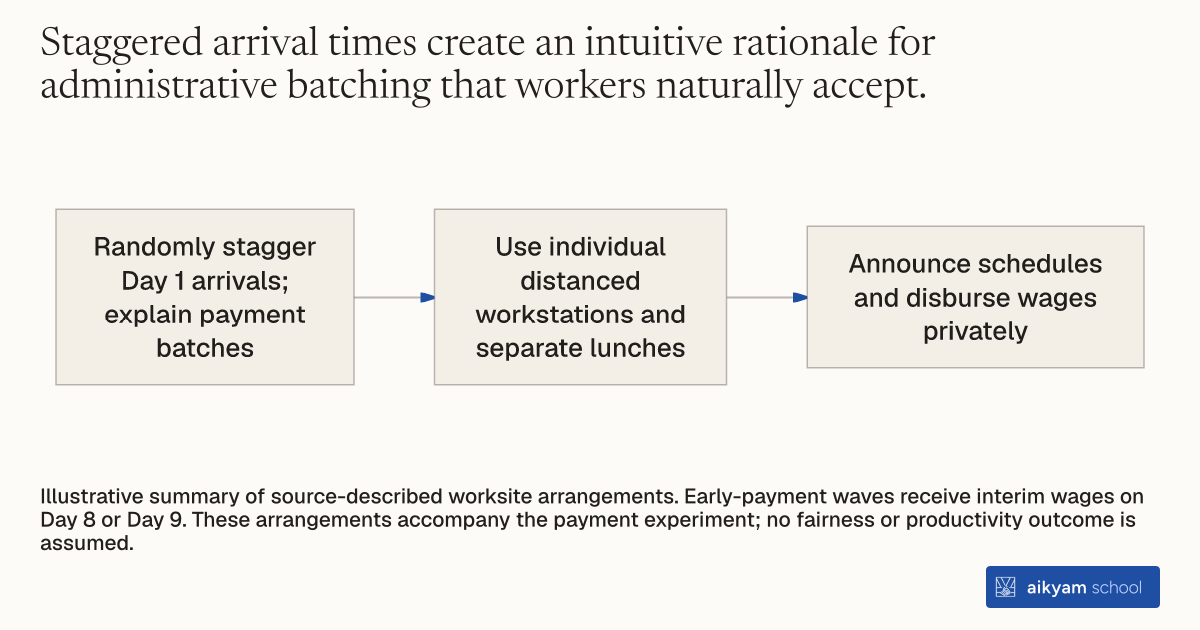
- Randomly stagger Day 1 arrivals; explain payment batches
- Use individual distanced workstations and separate lunches
- Announce schedules and disburse wages privately
Illustrative summary of source-described worksite arrangements. Early-payment waves receive interim wages on Day 8 or Day 9. These arrangements accompany the payment experiment; no fairness or productivity outcome is assumed.
See source →How
When to use
Set up a temporary manufacturing worksite where workers receive different payment schedules or compensation terms. It addresses the problem of workplace envy, peer comparisons, and perceived unfairness when employees witness colleagues receiving early cash disbursements. It helps project managers and researchers maintain high morale and prevent productivity drops caused by fairness concerns.
Mitigate peer comparison and unfairness concerns across workers on differential compensation schedules by introducing administrative batching and spatial isolation protocols.
- Assign workers to staggered arrival times on their first day of work to establish distinct administrative groups.
- Frame differences in wage payment schedules as standard batch assignments common in local contract labor markets.
- Position each participant in an individual, physically distanced workstation where they work and eat lunch separately from peers.
- Deliver individualized payment schedule announcements and wage disbursements privately to limit direct peer comparisons.
Why it works
Physical distancing minimizes social conversation and direct comparison of output or payout timing across participants.
Example
At five rural Odisha worksites employing 408 piece-rate manufacturing workers across 14 rounds, researchers assigned workers to staggered Day 1 start times and distanced individual workstations. On Day 9, after Wave A workers received early cash payments on Day 8, control group workers showed no differential output decline relative to Wave B workers, ruling out negative fairness spillover effects.
About the study
Participants
408 male casual wage laborers aged 18 to 55 across 14 experimental rounds in rural Odisha, India.
Study Design
Staggered Day 1 arrival times and spatially distanced individual workstations combined with private wage disbursements across randomized Wave A (Day 8 pay) and Wave B (Day 9 pay) treatment groups.
Results
Control group workers showed no statistically significant decrease in output after witnessing Wave A interim payments, with the Wave B payment day interaction coefficient being small and negative (-0.006 SDs, p=0.952).