Try, learn and adjust
Check classroom hours and stipends are delivered
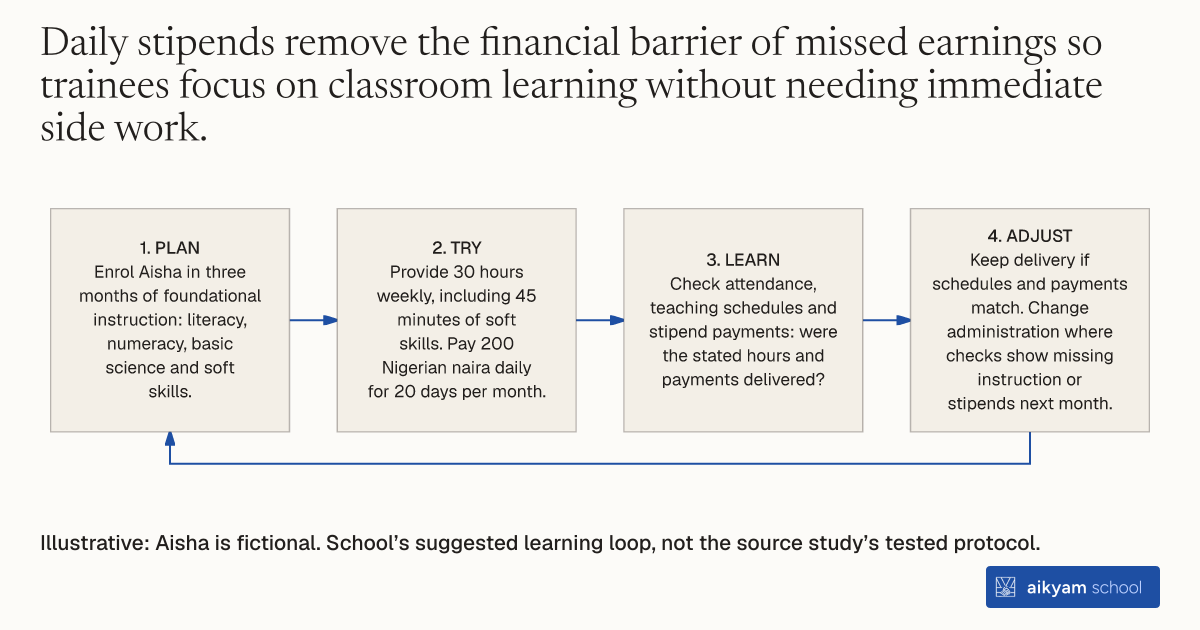
- Plan: Enrol Aisha in three months of foundational instruction: literacy, numeracy, basic science and soft skills.
- Try: Provide 30 hours weekly, including 45 minutes of soft skills. Pay 200 Nigerian naira daily for 20 days per month.
- Learn: Check attendance, teaching schedules and stipend payments: were the stated hours and payments delivered?
- Adjust: Keep delivery if schedules and payments match. Change administration where checks show missing instruction or stipends next month.
Illustrative: Aisha is fictional. School’s suggested learning loop, not the source study’s tested protocol.
See source →School’s suggested, untested loop. Observe hours, attendance and stipend receipt. The reported literacy-score increase was not statistically significant.
How
When to use
Impoverished youth in low-resource settings often lack foundational literacy and soft skills needed for vocational training. Financial hardship forces young people to prioritize immediate income over classroom learning. Providing daily stipends alongside basic classroom instruction allows vulnerable youth to attend classes without sacrificing daily sustenance.
Deliver basic academic and interpersonal skills instruction to impoverished youth while providing financial support to offset attendance costs.
- Enroll eligible adolescents into classroom-based foundational training across skills centers.
- Provide 3 months of classroom instruction covering foundational literacy, numeracy, and basic science.
- Dedicate 45 minutes per week to soft skills instruction covering goal-setting and interpersonal communication.
- Conduct classroom instruction for 30 hours per week over the 3-month period.
- Pay each participant a daily stipend of 200 Nigerian naira for 20 days per month to cover food and transport costs.
Why it works
Foundational academic and interpersonal skills prepare disadvantaged adolescents to absorb subsequent trade-specific technical instruction.
Example
In Northern Nigeria, 900 impoverished youth participated in 3 months of foundational instruction across six Community Skills Development Centers. Participants attended 30 hours of instruction weekly, including literacy, numeracy, science, and weekly soft skills. Program administrators paid each student 200 Nigerian naira daily for 20 days per month to cover food and travel expenses.
About the study
Participants
900 youth aged 15 to 24 in Kaduna and Katsina states, Northern Nigeria, randomized into training.
Study Design
Randomized controlled trial comparing 900 assigned trainees against 924 control group participants receiving no training.
Results
The foundational component contributed to an overall 73 percent program completion rate, though literacy test scores increased by an statistically insignificant 0.014 standard deviations.