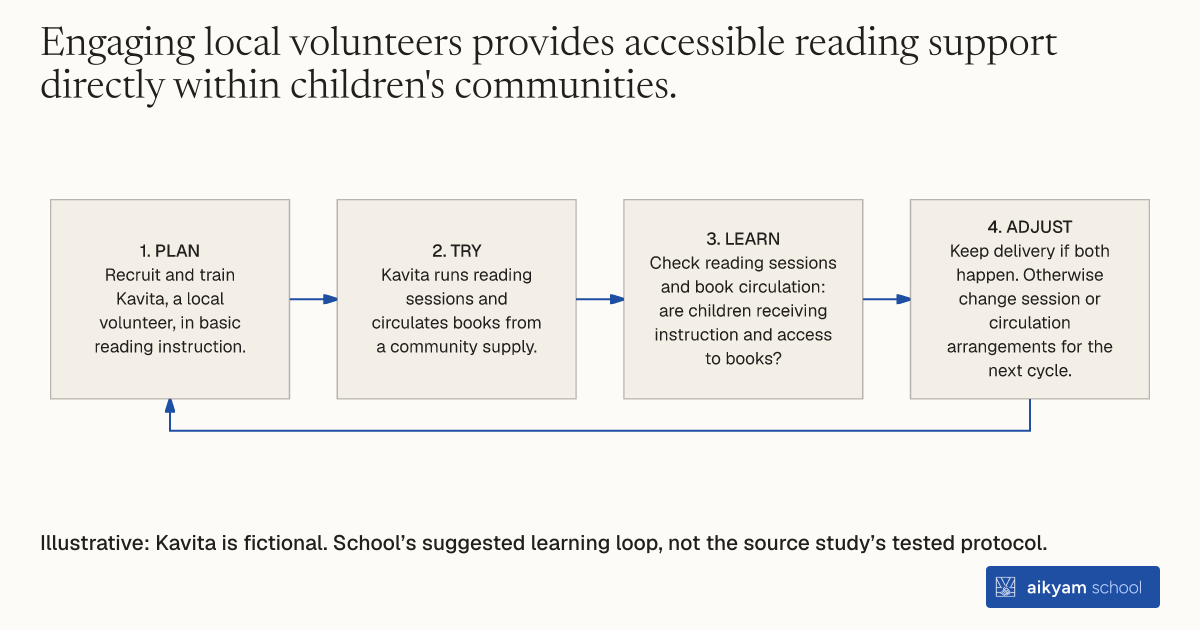
Try, learn and adjust
Check community reading and book circulation
- Plan: Recruit and train Kavita, a local volunteer, in basic reading instruction.
- Try: Kavita runs reading sessions and circulates books from a community supply.
- Learn: Check reading sessions and book circulation: are children receiving instruction and access to books?
- Adjust: Keep delivery if both happen. Otherwise change session or circulation arrangements for the next cycle.
Illustrative: Kavita is fictional. School’s suggested learning loop, not the source study’s tested protocol.
See source →School’s suggested, untested learning loop. Observe reading sessions and book circulation. No literacy improvement is assumed.
How
When to use
Many children in rural communities lack foundational reading skills and access to reading materials outside of school. Standard school instruction does not always ensure functional literacy for all pupils. Community leaders deploy local volunteers to deliver basic reading instruction and build circulating book collections for children.
Train local community volunteers to provide basic reading instruction and distribute books to children throughout the village.
- Recruit local community members to serve as volunteer literacy instructors and book distributors.
- Train volunteers in basic reading instruction methodologies tailored for children falling behind.
- Establish a community supply of children's books for circulation among neighborhood youth.
- Conduct community reading sessions to give basic reading instruction directly to children.
- Circulate books among local children to encourage self-study and foster a community culture of learning.
Why it works
Building a circulating supply of books enables continuous self-study and fosters a broader culture of learning.
Example
Pratham implemented the Read India program in rural communities across Indian states starting in late 2002. Using local volunteers to deliver basic reading instruction and circulate books, the program reached over 160,000 children by late 2004.