Research steps
Price insurance using simulated rainfall
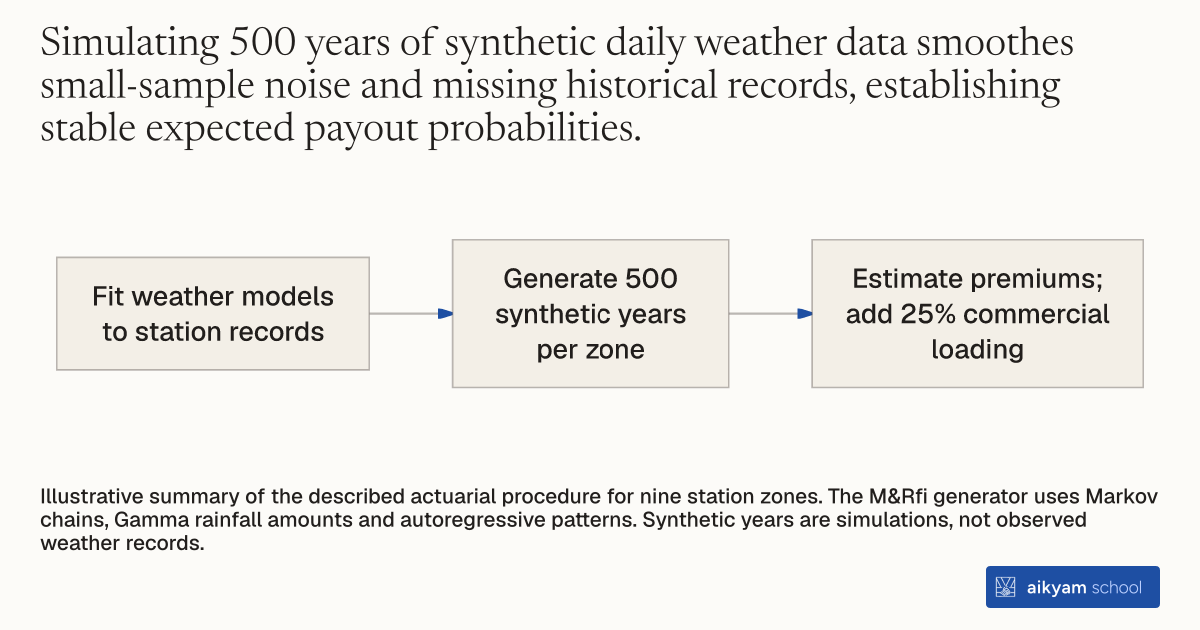
- Fit weather models to station records
- Generate 500 synthetic years per zone
- Estimate premiums; add 25% commercial loading
Illustrative summary of the described actuarial procedure for nine station zones. The M&Rfi generator uses Markov chains, Gamma rainfall amounts and autoregressive patterns. Synthetic years are simulations, not observed weather records.
See source →How
When to use
Historical weather records in developing regions are often incomplete or span too few years to estimate rare drought risks accurately. Actuaries require long-term precipitation data to calculate fair insurance premiums without overpricing policies or risking insolvency. Stochastic weather series generation simulates synthetic long-term weather data to price agricultural index insurance contracts.
Simulate long-term synthetic daily precipitation series using a stochastic weather generator to calculate actuarially fair premiums and commercial loading for weather index insurance.
- Obtain historical daily rainfall records from local meteorological stations, accounting for missing observation days.
- Parameterize a stochastic weather generator using a Markov chain to model dry and wet spell sequences.
- Fit a Gamma distribution to observed positive daily rainfall totals to capture right-skewed precipitation amounts.
- Run an autoregressive model within the weather generator to simulate multi-day pseudo-cycles and seasonal weather patterns.
- Generate 500 years of synthetic daily weather data possessing the same statistical properties as historical station observations.
- Calculate actuarially fair baseline premiums from simulated payout frequency across target zones, adding a 25 percent commercial loading markup for the insurer.
Why it works
Adding a fixed commercial loading markup ensures the insurer covers administrative overhead and profit margins while keeping zonal rates actuarially grounded.
Example
Nyala Insurance and research agronomists used the M&Rfi stochastic weather generator on National Meteorological Agency records to simulate 500 years of daily rainfall across station zones in Amhara, Ethiopia, adding 25 percent commercial loading to establish market premium prices.
About the study
Participants
9 weather station zones in Amhara Region, Ethiopia, serving 49 panel study villages.
Study Design
Stochastic daily weather generator parameterization using Markov chains, Gamma distributions, and autoregressive modeling on historical station data to price index policies.
Results
Generated 500 synthetic years of daily precipitation data per weather station zone, establishing actuarially fair baseline premium rates augmented by a 25 percent commercial loading fee.