Research steps
Separate learning from price anchoring
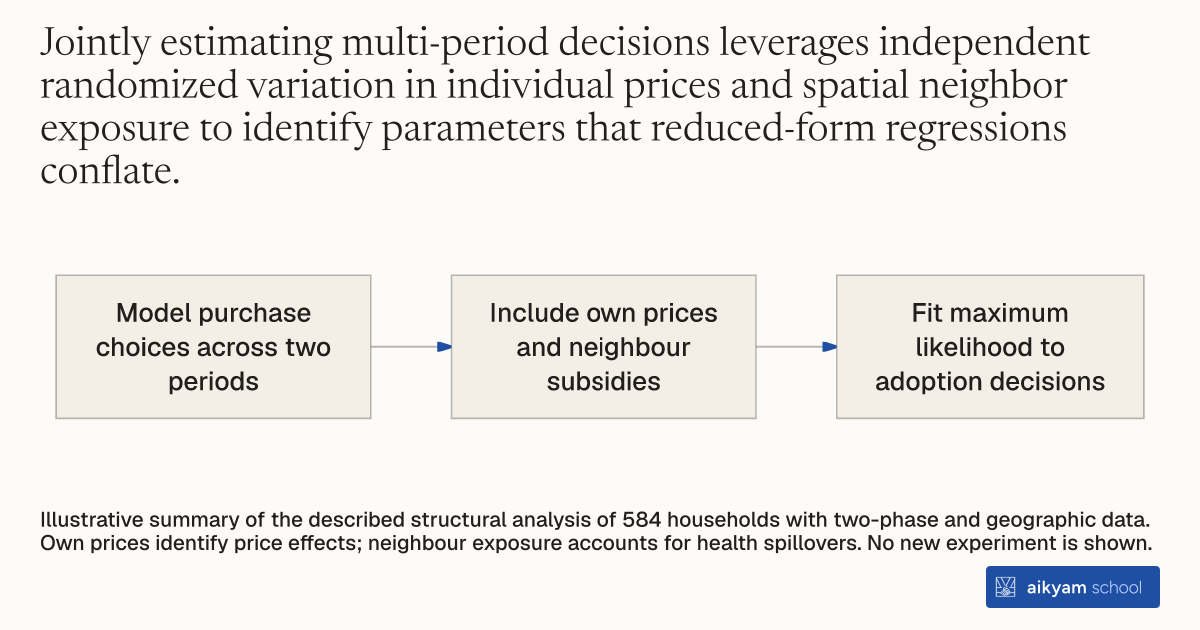
- Model purchase choices across two periods
- Include own prices and neighbour subsidies
- Fit maximum likelihood to adoption decisions
Illustrative summary of the described structural analysis of 584 households with two-phase and geographic data. Own prices identify price effects; neighbour exposure accounts for health spillovers. No new experiment is shown.
See source →How
When to use
Researchers and policy evaluators need to untangle competing structural mechanisms driving technology adoption when reduced-form experimental estimates combine offsetting behavioral effects. Introductory subsidies can simultaneously generate positive learning from product trial and negative price anchoring or health spillover effects. Estimating an experience-good structural model allows evaluators to isolate and quantify these distinct behavioral parameters.
Estimate a structural experience-good maximum likelihood model using multi-period purchase decisions and exogenous spatial exposure to separate learning from reference-dependent price anchoring.
- Formulate a dynamic decision model combining expected utility, gain-loss reference utility, and disease risk parameters across adoption periods.
- Specify logistic preference shock distributions to express individual purchase probabilities as closed-form maximum likelihood functions.
- Incorporate exogenous variation in own Phase 1 assigned prices to identify price sensitivity and reference-dependent anchoring parameters.
- Integrate exogenous variation in neighbor subsidy density within fixed spatial radii to control for disease burden shifts and isolate health spillovers.
- Maximize the log-likelihood function across combined initial and long-run household adoption decisions to estimate baseline priors, social learning, and own-experience learning parameters.
Why it works
Maximum likelihood structural estimation holds health spillovers and reference prices constant, isolating how firsthand product experience modifies perceived quality.
Example
In Western Kenya, researchers estimated a structural maximum likelihood model across 584 households in four villages to disentangle Phase 1 and Phase 2 bed net adoption decisions.
About the study
Participants
584 rural households with complete GIS and two-phase adoption data in Busia District, Western Kenya.
Study Design
Structural maximum likelihood estimation using logistic preference shocks, combining two-period purchase choices with exogenous spatial neighbor subsidy density.
Results
Model estimates revealed a large, statistically significant total learning effect that increased perceived product quality by 41 percent (equivalent to a 30 percent price drop), while the price anchoring parameter was negligible at 0.0015.