Research procedure
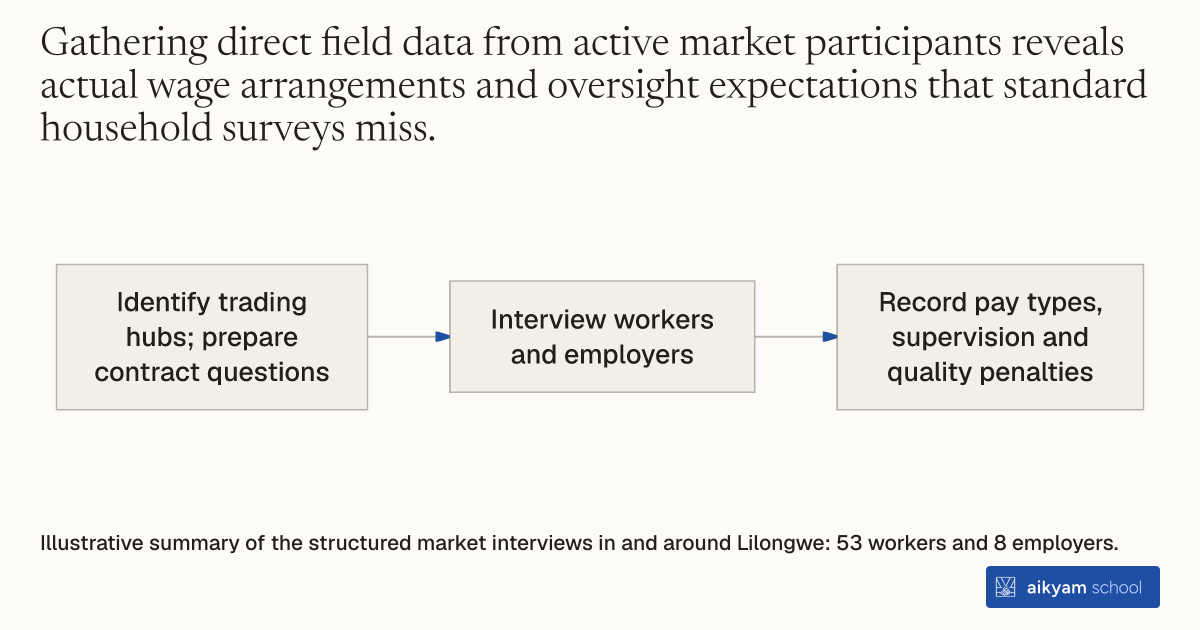
Record local labour contracts
- Identify trading hubs; prepare contract questions
- Interview workers and employers
- Record pay types, supervision and quality penalties
Illustrative summary of the structured market interviews in and around Lilongwe: 53 workers and 8 employers.
See source →How
When to use
When designing novel employment interventions, researchers and managers often lack benchmark data on existing local informal contracts. Standard national household surveys frequently group casual day labor under broad categories without recording payment types or monitoring rules. Conducting qualitative surveys at local commercial hubs helps program planners map real-world contract structures before introducing new labor schemes.
Survey local casual workers and employers at commercial trading hubs to establish baseline informal contract norms and supervision practices.
- Identify major regional agri-processing centers and trading posts where casual day laborers gather for work.
- Draft a structured questionnaire covering job task types, payment structures, monitoring methods, and quality penalties.
- Deploy field enumerators to interview active casual laborers across target trading post locations.
- Interview local commercial employers and supervisors who hire day laborers at the same trading hubs.
- Record the relative proportions of time-rate versus piece-rate contracts across different task categories.
- Document supervisor oversight frequency and specific quality penalty enforcement mechanisms reported by respondents.
Why it works
Understanding local contractual norms ensures that experimental or operational contracts reflect realistic market conditions.
Example
Researchers interviewed 53 casual workers and 8 employers at trading posts and agri-processing centers in and around Lilongwe, Malawi. They found that 55 percent of workers were paid time rates and 45 percent were paid piece rates, while 74 percent reported quality monitoring.
About the study
Participants
53 casual workers and 8 employers in and around Lilongwe trading posts and agri-processing centers in Malawi.
Study Design
Qualitative market survey using targeted structured interviews with active casual day laborers and commercial employers.
Results
55 percent of informal ganyu contracts used time rates while 45 percent used piece rates, and quality monitoring was present in 74 percent of contracts overall (62.5 percent for piece-rate contracts vs 82.8 percent for time-rate contracts).