Research selection
Select firms for recruitment outreach
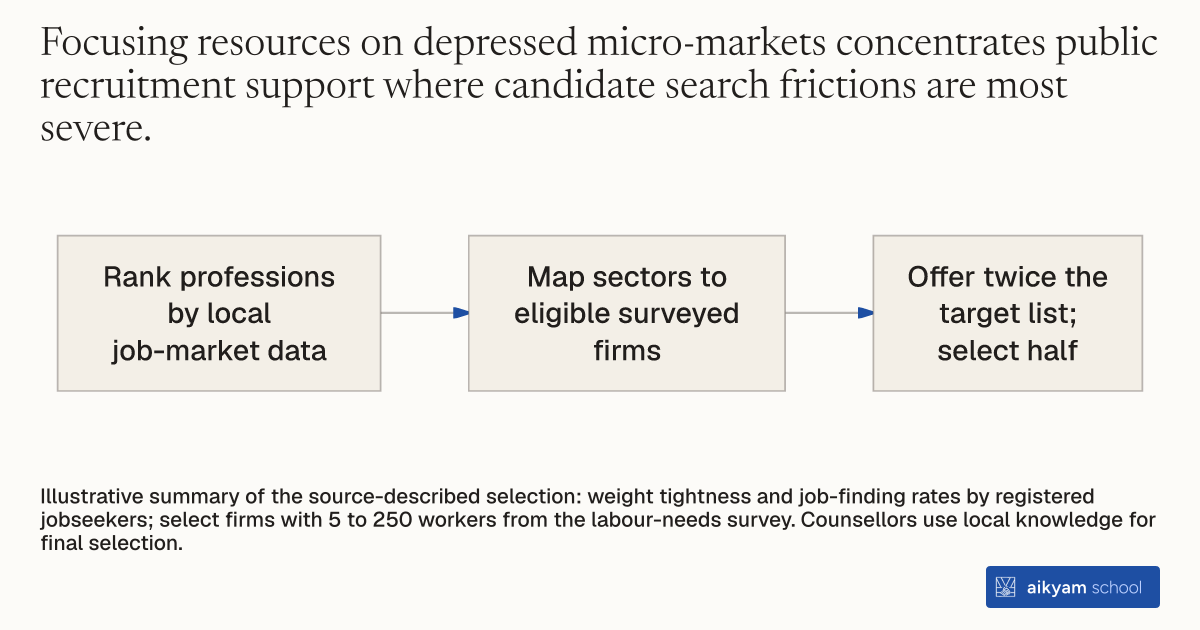
- Rank professions by local job-market data
- Map sectors to eligible surveyed firms
- Offer twice the target list; select half
Illustrative summary of the source-described selection: weight tightness and job-finding rates by registered jobseekers; select firms with 5 to 250 workers from the labour-needs survey. Counsellors use local knowledge for final selection.
See source →How
When to use
Public agencies need to decide which sectors and firms to target for proactive recruitment assistance. Broad outreach across all industries risks wasting counselor effort in healthy markets with high candidate demand. Ranking local professions pinpoints depressed micro-markets where jobseekers face the lowest hiring probability.
Select target employment sectors by calculating local job-finding probabilities and labor market tightness for every participating public employment agency.
- Researchers obtain local labor market tightness and job-finding rates for all professions represented across participating local employment agency areas.
- Calculate a priority ranking of professions for each agency by weighting local tightness and job-finding probabilities by the stock of registered jobseekers.
- Convert priority professions into corresponding economic sectors using a profession-sector correspondence table.
- Match the ranked sector list to local firms that employ between 5 and 250 workers and participated in the annual labor needs survey.
- Provide each local agency with an oversampled list containing twice the required number of top-ranked priority firms.
- Local counselors review the oversampled list and select half of the firms using local expertise for final study assignment.
Why it works
This prevents market overcrowding and keeps the proportion of treated firms small within any single local labor market.
Example
Researchers and the French Public Employment Service targeted 129 local employment agencies across mainland France during 2014. They ranked professions by local tightness and job-finding rates, merged them to sectors, and sampled small and medium-sized firms with 5 to 250 employees from the 2014 Labor Needs survey. This generated a validated trial sample of 7,438 unique firms across 22 mainland regions.
About the study
Participants
7,438 small and medium-sized firms with 5 to 250 employees across 129 local employment agencies in mainland France.
Study Design
Stratified randomized controlled trial targeting firms in low-tightness micro-markets with a median tightness of 0.35 during a 6.5-month sanctuary period.
Results
Target selection in low-tightness markets yielded a 24% increase in permanent vacancy postings (0.047 additional vacancies over 0.199 control mean, p < 0.01) and a 10.2% increase in permanent contract hires of registered jobseekers (0.046 additional hires over 0.450 control mean, p < 0.05).