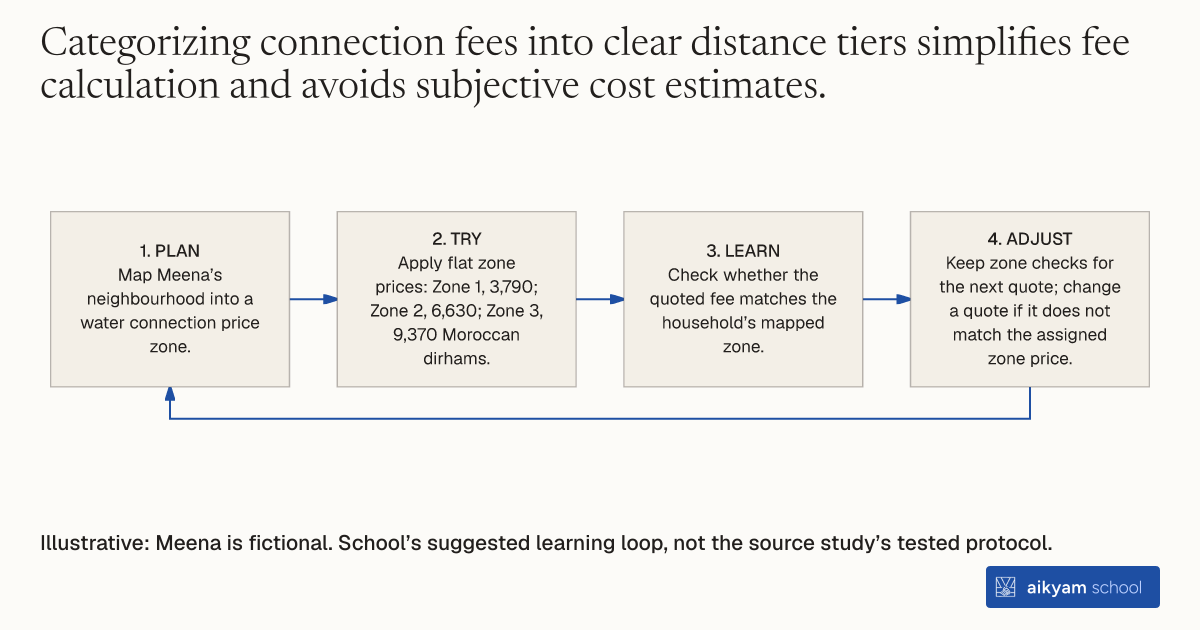
Try, learn and adjust
Check distance-based connection fees
- Plan: Map Meena’s neighbourhood into a water connection price zone.
- Try: Apply flat zone prices: Zone 1, 3,790; Zone 2, 6,630; Zone 3, 9,370 Moroccan dirhams.
- Learn: Check whether the quoted fee matches the household’s mapped zone.
- Adjust: Keep zone checks for the next quote; change a quote if it does not match the assigned zone price.
Illustrative: Meena is fictional. School’s suggested learning loop, not the source study’s tested protocol.
See source →School’s suggested, untested loop. Observe mapped zones and connection fees; no demand or cost-recovery result is assumed.
How
When to use
Utility extension programs face varying capital installation costs based on household distance from existing main water pipes. This method tiers connection prices into discrete distance brackets rather than charging uniform fees or custom individual quotes. It provides transparent, predictable pricing structures for low-income households while enabling full cost recovery for utility operators.
Structure household water connection fees into discrete price categories based on distance from the primary distribution grid.
- Utility engineers map inner-city residential neighborhoods to delineate geographic pricing zones relative to the existing water main.
- Set the connection price for Zone 1 closest to the grid at 3,790 Moroccan dirhams.
- Set the connection price for Zone 2 at an intermediate distance at 6,630 Moroccan dirhams.
- Set the connection price for Zone 3 furthest from the grid at 9,370 Moroccan dirhams.
- Require all households within a zone to pay the flat price assigned to their zone regardless of individual plot variations.
Why it works
Flat price brackets allow utilities to cover the full capital works cost while giving residents clear, standardized price expectations.
Example
In Tangiers, Morocco, Amendis structured connection costs across 845 eligible households into three distance-based price zones: 3,790 dirhams (Zone 1), 6,630 dirhams (Zone 2), and 9,370 dirhams (Zone 3). Regressions showed that demand remained high across all tiers, with 68.7 percent adoption when combined with credit financing regardless of the price tier.
About the study
Participants
845 low-income eligible households across 732 plots in Tangiers, Morocco.
Study Design
Econometric linear probability regression of connection take-up on price zone dummy variables among treatment group households.
Results
Distance price tiering had little effect on connection demand: relative to Zone 1, Zone 2 demand was 9.1 percentage points lower and Zone 3 demand was 4.3 percentage points higher, with neither difference being statistically significant.