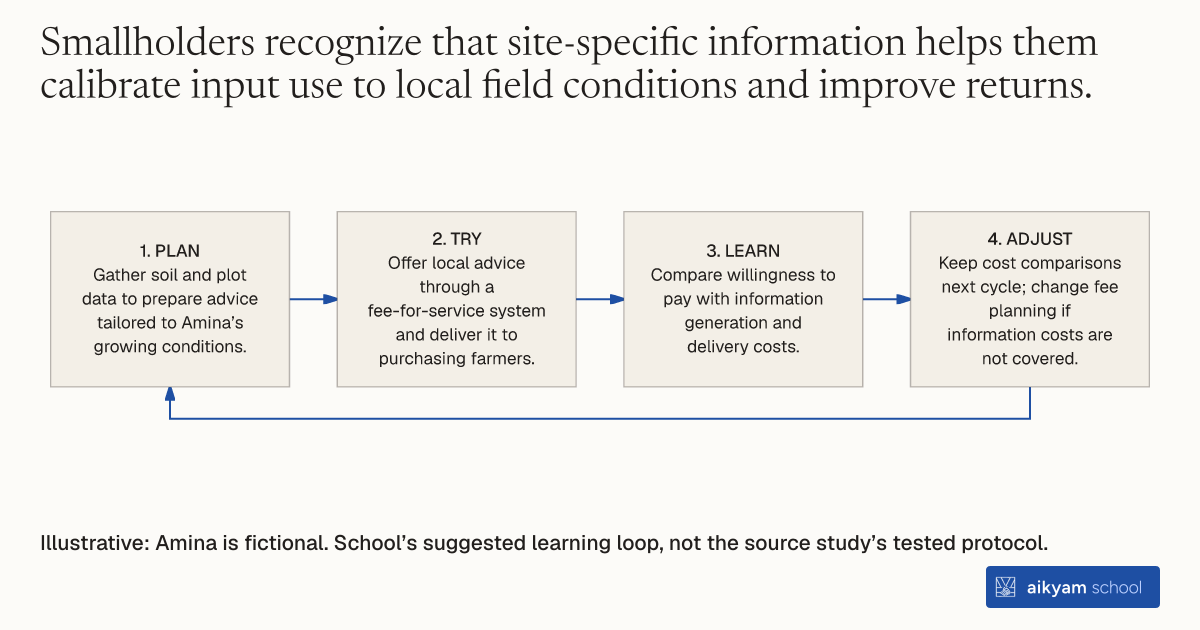
Try, learn and adjust
Check fees against local advice costs
- Plan: Gather soil and plot data to prepare advice tailored to Amina’s growing conditions.
- Try: Offer local advice through a fee-for-service system and deliver it to purchasing farmers.
- Learn: Compare willingness to pay with information generation and delivery costs.
- Adjust: Keep cost comparisons next cycle; change fee planning if information costs are not covered.
Illustrative: Amina is fictional. School’s suggested learning loop, not the source study’s tested protocol.
See source →School’s suggested learning loop; not a tested source procedure. Observe willingness to pay and costs separately. The source reports that willingness to pay exceeded costs, not that every service achieved cost recovery.
How
When to use
Generic agricultural advisory services fail to account for local soil and microclimate variations across smallholder plots. Farmers hesitate to invest in new inputs without site-specific information to guide application decisions. This method enables extension organizations to deliver tailored agricultural information to smallholders on a cost-recovering basis.
Deliver site-specific agricultural advisory services to smallholders by charging fee-for-service rates that cover data generation and transmission costs.
- Extension officers gather localized soil and plot-level agricultural data across rural farming communities.
- Extension managers develop customized advisory messages tailored to specific local growing conditions.
- Program administrators establish a fee-for-service delivery system for smallholders desiring localized information.
- Smallholder farmers purchase access to localized agricultural advice through mobile or direct channels.
- Extension agents deliver tailored agricultural recommendations to enrolled farmers to calibrate input decisions on their plots.
Why it works
Farmers' willingness to pay demonstrates high perceived value, allowing extension services to recover operating costs.
Example
In Western Kenya, researchers evaluated small-scale maize farmers' valuation of local agricultural information. Farmers' willingness to pay for site-specific agricultural advice exceeded the financial costs of generating and delivering the information.
About the study
Participants
Small-scale maize farmers in Western Kenya.
Study Design
Randomized field evaluation assessing smallholder farmers' willingness to pay for localized agricultural information compared against operational costs.
Results
Smallholder farmers' willingness to pay for local agricultural information exceeded the implementation costs of generating and delivering the information.