Try, learn and adjust
Check daily routines against personal goals
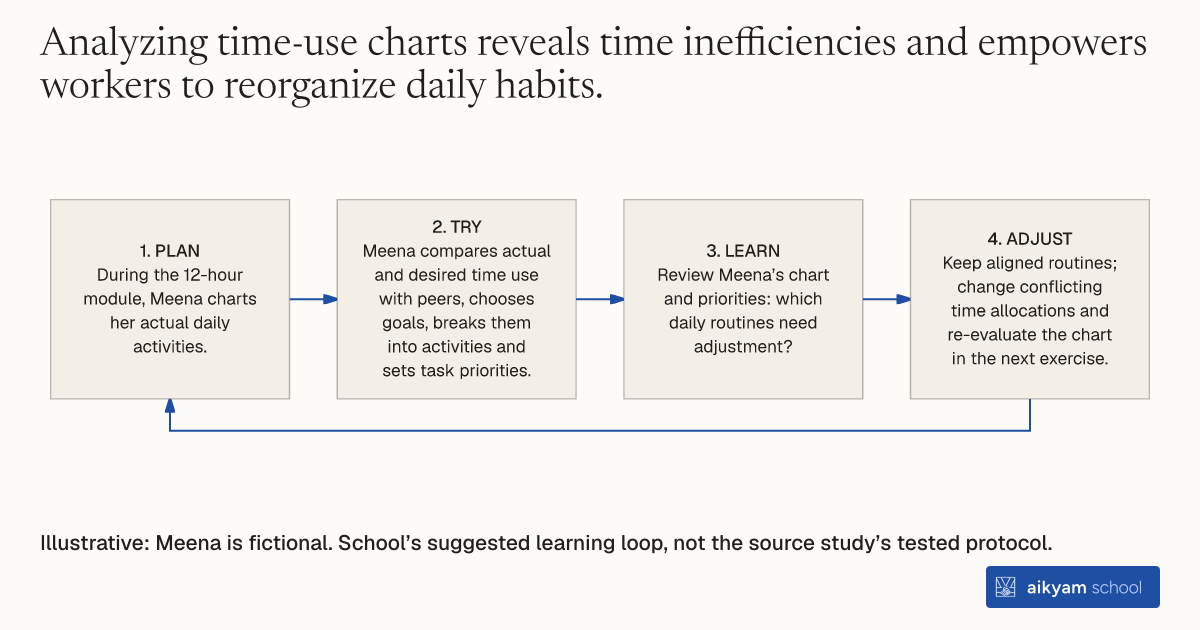
- Plan: During the 12-hour module, Meena charts her actual daily activities.
- Try: Meena compares actual and desired time use with peers, chooses goals, breaks them into activities and sets task priorities.
- Learn: Review Meena’s chart and priorities: which daily routines need adjustment?
- Adjust: Keep aligned routines; change conflicting time allocations and re-evaluate the chart in the next exercise.
Illustrative: Meena is fictional. School’s suggested learning loop, not the source study’s tested protocol.
See source →School’s suggested learning loop, not a tested protocol. Observe time-use charts, peer feedback and alignment with chosen goals.
How
When to use
Frontline factory workers often struggle with personal goal planning and time allocation, leading to reactive task execution and low forward-looking motivation. Unorganized daily routines hamper both workplace focus and personal financial planning. Deliver structured time-use charting, goal setting, and task prioritization exercises to low-wage female workers to align daily time allocation with long-term career and household goals.
Train workers to construct and analyze personal time-use charts and execute structured goal-setting and prioritization exercises across twelve classroom hours.
- Direct participants to construct a detailed time-use chart documenting their actual daily activity allocation.
- Facilitate group reflection and peer feedback sessions where participants compare their current time allocation against their desired schedule.
- Guide participants to select specific long-term personal goals, such as accumulating educational savings for their children or achieving factory production targets.
- Instruct workers to break down each chosen goal into actionable, step-by-step activities required for achievement.
- Teach participants to classify daily workplace and household tasks into standardized priority levels.
- Have participants re-evaluate and adjust their daily routines to align time allocation with prioritized goals.
Why it works
Connecting daily workplace motivation to concrete personal goals increases identified autonomous regulation and forward-looking effort.
Example
Trainers delivered a 12-hour Time and Stress Management module to 1,087 female garment workers across 5 factories in Bengaluru, India. Participants constructed personal time-use charts and mapped workplace motivation to long-term family targets, which contributed to an 8.04 percentage point increase in savings for children's education and an 8.85 percentage point increase in expectations that their children would achieve education beyond college.
About the study
Participants
621 female garment workers in the primary RCT endline survey sample across 5 export factories in Bengaluru, India.
Study Design
Randomized controlled trial assessing cross-sectional survey outcomes using retention inverse probability weighting and line-level error clustering following a 12-hour Time and Stress Management module.
Results
Goal-setting and time-use training increased targeted savings for children's education by 8.04 percentage points (p < 0.05; relative to a control mean of 26.5%) and increased expectations for children's education beyond college by 8.85 percentage points (p < 0.01; relative to a control mean of 11.7%).