Try, learn and adjust
Check merit credentials before job matching
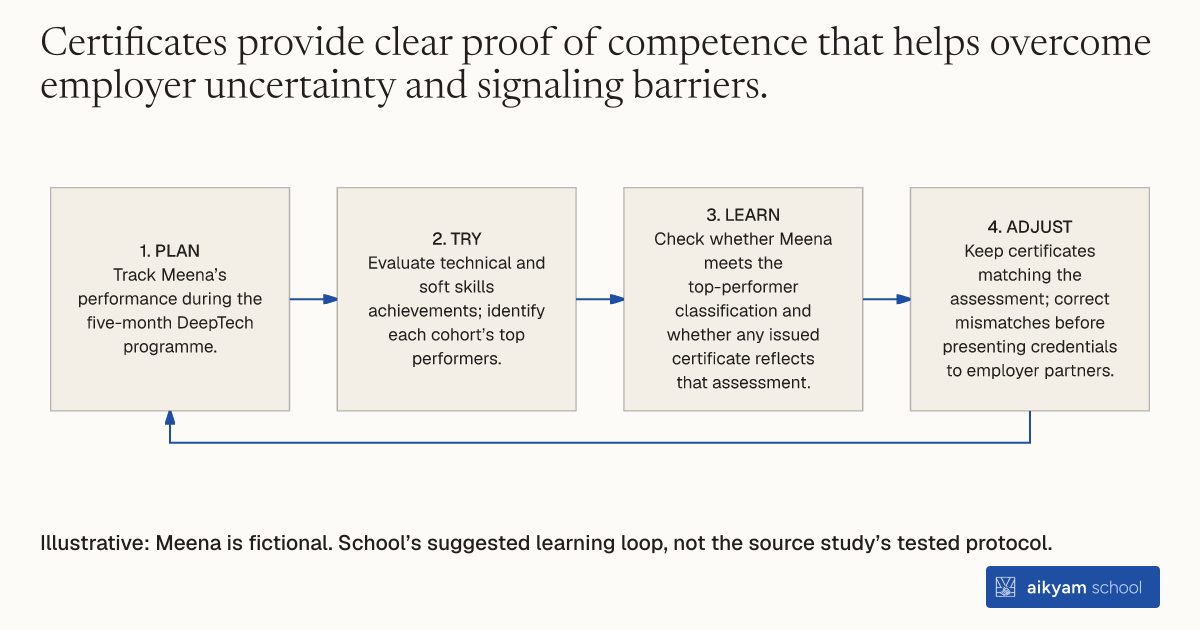
- Plan: Track Meena’s performance during the five-month DeepTech programme.
- Try: Evaluate technical and soft skills achievements; identify each cohort’s top performers.
- Learn: Check whether Meena meets the top-performer classification and whether any issued certificate reflects that assessment.
- Adjust: Keep certificates matching the assessment; correct mismatches before presenting credentials to employer partners.
Illustrative: Meena is fictional. School’s suggested learning loop, not the source study’s tested protocol.
See source →School’s suggested learning loop, not a tested protocol. Observe course performance, top-performer classification and merit certificates before placement matching.
How
When to use
Graduates from lower tier colleges often face employer skepticism regarding their technical expertise. Training program managers need an objective mechanism to highlight high-achieving candidates during recruitment. Award merit certificates to high-performing participants to strengthen skill signaling to prospective employers.
Award merit certificates to high-performing training participants to communicate candidate quality to corporate recruiters.
- Track participant performance throughout the five-month DeepTech job training program.
- Evaluate student achievements in technical coursework and soft skills modules.
- Identify top performers in each training cohort based on overall course performance.
- Issue formal merit certificates to top-performing graduates prior to job matching.
- Present the merit credentials to employer partners during job placement matching.
Why it works
Highlighting top performers allows candidates from lower tier colleges to stand out during corporate hiring processes.
Example
NGO Anudip awarded merit certificates to top performers among 2,333 training participants in urban Delhi and Maharashtra to strengthen candidate signaling to tech companies.
About the study
Participants
2,333 college graduates (1,633 men and 700 women) with engineering or computer science degrees in urban Delhi and Maharashtra, India.
Study Design
Randomized controlled trial evaluating a five-month DeepTech job training program that includes merit certification for top performers compared against a 1,000-person control group.
Results
Historical program data shows 50 to 70 percent of trained participants secured STEM jobs; experimental impacts of certification on employment outcomes are ongoing.