Try, learn and adjust
Check pit construction and later maintenance
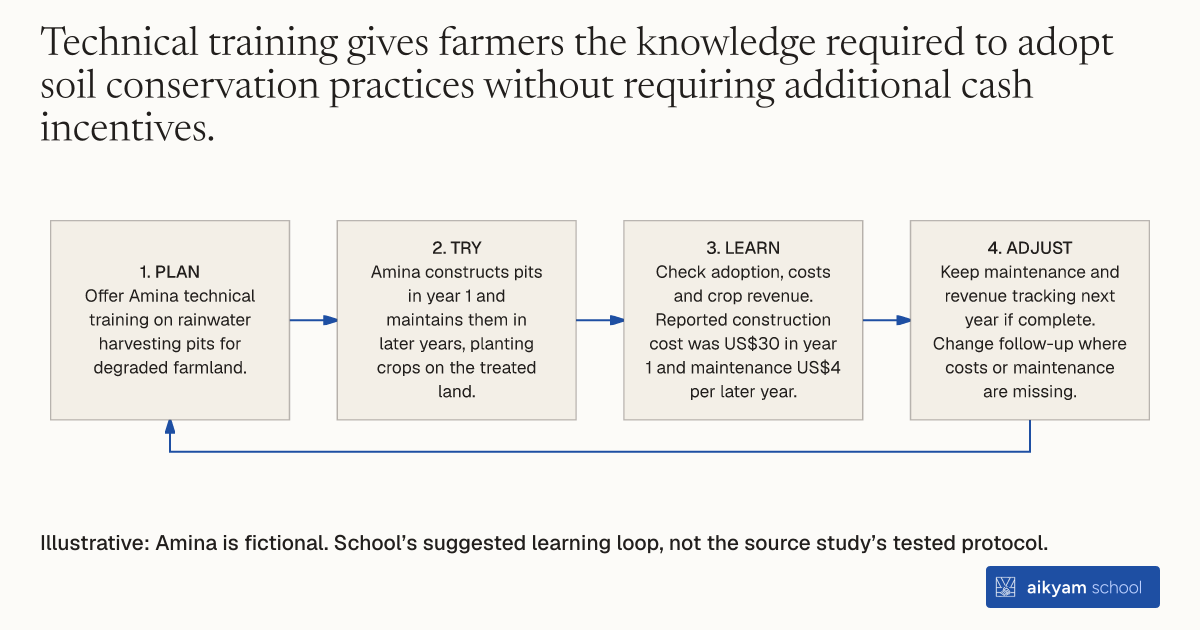
- Plan: Offer Amina technical training on rainwater harvesting pits for degraded farmland.
- Try: Amina constructs pits in year 1 and maintains them in later years, planting crops on the treated land.
- Learn: Check adoption, costs and crop revenue. Reported construction cost was US$30 in year 1 and maintenance US$4 per later year.
- Adjust: Keep maintenance and revenue tracking next year if complete. Change follow-up where costs or maintenance are missing.
Illustrative: Amina is fictional. School’s suggested learning loop, not the source study’s tested protocol.
See source →School’s suggested, untested loop. Observe adoption, maintenance, costs and revenue; distinguish first-year construction from later upkeep.
How
When to use
Farmers face severe soil degradation and low water retention in dry agricultural regions. This practice helps smallholder farmers capture rainwater and restore degraded land. It targets rural households in drought-prone areas where water scarcity reduces crop yields.
Provide localized informational training to farmers on constructing rainwater harvesting pits to increase soil water retention.
- Extension workers deliver technical training on building rainwater harvesting pits to smallholder farmers.
- Farmers construct rainwater harvesting pits on degraded farmland during the first year at a cost of US$30.
- Farmers maintain the constructed rainwater harvesting pits in subsequent years at a cost of US$4 per year.
- Farmers plant crops on the treated land to increase water retention and restore degraded soil over 2 years.
Why it works
The harvesting pits increase water retention in degraded soil, which raises total agricultural production and revenue over time.
Example
In Niger, researchers offered farmers training on building rainwater harvesting pits to combat soil degradation. Trained households increased adoption by 91 percentage points compared to 4 percent among non-recipients. Construction cost US$30 in year 1 and US$4 in subsequent years, increasing agricultural revenue by 10 to 13 percent and first-year profit by US$3.
About the study
Participants
Smallholder farming households facing severe soil degradation in Niger.
Study Design
Randomized controlled trial comparing informational training alone against training combined with cash transfers and an untreated control group.
Results
Informational training increased practice adoption by 91 percentage points compared to a 4 percent adoption rate in the control group. Adding cash transfers to training yielded no additional adoption increase. Pit construction cost US$30 in year 1 and US$4 in subsequent years, increasing total revenue by 10-13 percent (US$34 in year 1 to US$37 by year 3) and raising profitability by US$3 in year 1.