Research design
Compare adaptation and migration support
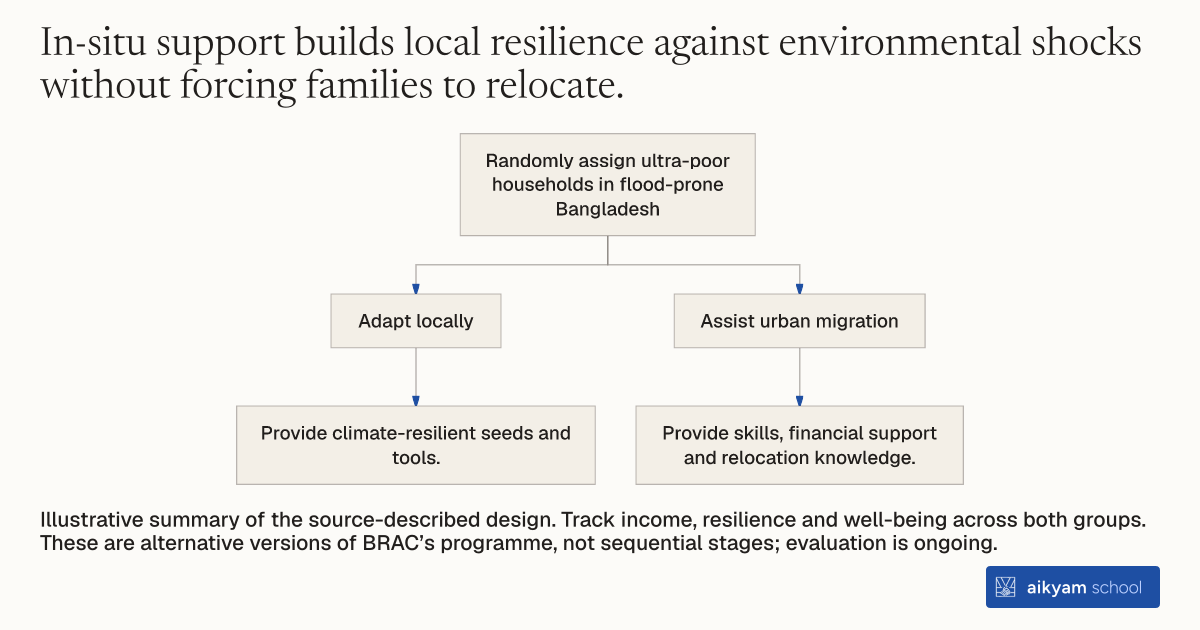
Randomly assign ultra-poor households in flood-prone Bangladesh
- Adapt locally
- Provide climate-resilient seeds and tools.
- Assist urban migration
- Provide skills, financial support and relocation knowledge.
Illustrative summary of the source-described design. Track income, resilience and well-being across both groups. These are alternative versions of BRAC’s programme, not sequential stages; evaluation is ongoing.
See source →How
When to use
In flood-prone rural areas, climate change disrupts traditional agricultural livelihoods and increases poverty. Standard assistance programs focus exclusively on local support, which fails when environments become uninhabitable. This method applies to development organizations evaluating whether to support in-situ climate adaptation or assist voluntary urban migration for vulnerable rural households.
Test the comparative impacts of providing in-situ climate adaptation assistance versus assisted migration support for ultra-poor rural households.
- Program officers identify ultra-poor households residing in flood-prone rural regions.
- Officers randomly assign participating households to receive either in-situ adaptation support or assisted urban migration support.
- The in-situ group receives agricultural assistance, including climate-resilient seeds and tools, to adapt locally.
- The migration group receives vocational skill-building, financial support, and relocation knowledge to move to urban centers.
- Program staff track household income, climate resilience, and well-being across rural and urban locations in Bangladesh.
Why it works
Assisted migration removes financial and information barriers, allowing vulnerable households to permanently move away from severe climate hazards.
Example
In Bangladesh, researchers partnered with BRAC to test two versions of the Ultra-Poor Graduation Initiative, comparing local agricultural adaptation support against financial and vocational assistance to migrate from flood-prone rural areas to cities.
About the study
Participants
Rural poor households in flood-prone areas in Bangladesh.
Study Design
Randomized controlled trial evaluating two versions of BRAC's Ultra-Poor Graduation Initiative (in-situ adaptation vs. assisted urban migration).
Results
Ongoing randomized evaluation measuring the relative impacts of local agricultural adaptation support versus skill-building and financial assistance for urban migration.