Try, learn and adjust
Check rainwater-harvesting demonstrations lead to recorded adoption
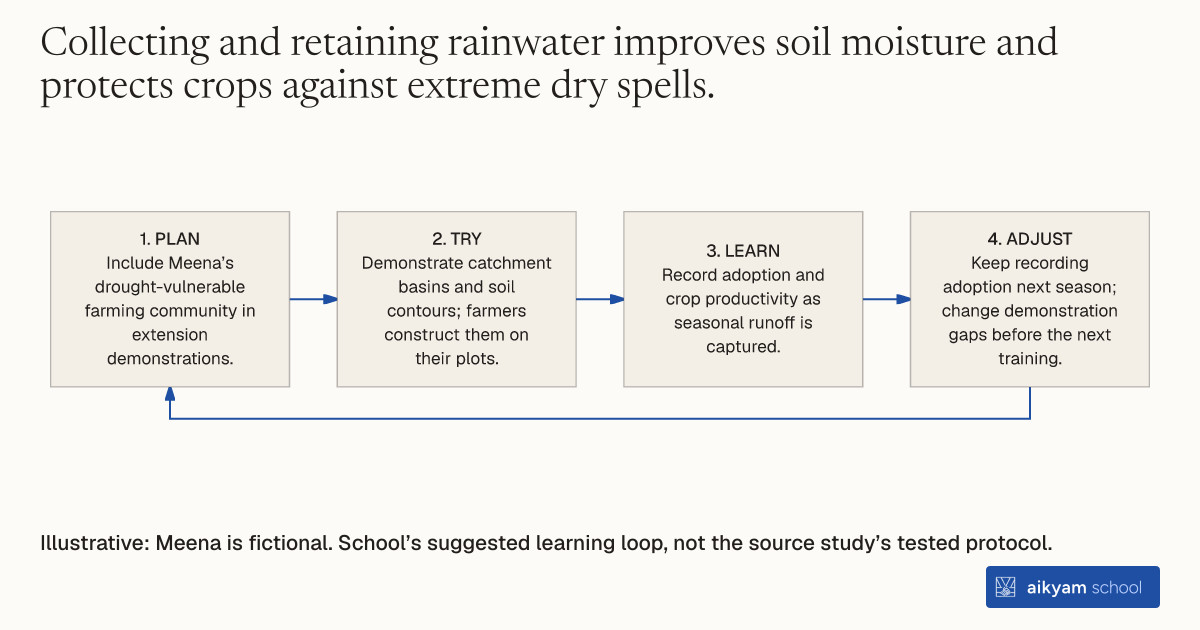
- Plan: Include Meena’s drought-vulnerable farming community in extension demonstrations.
- Try: Demonstrate catchment basins and soil contours; farmers construct them on their plots.
- Learn: Record adoption and crop productivity as seasonal runoff is captured.
- Adjust: Keep recording adoption next season; change demonstration gaps before the next training.
Illustrative: Meena is fictional. School’s suggested learning loop, not the source study’s tested protocol.
See source →Adoption and crop productivity; no numerical or settled impact estimate is supplied. School’s suggested learning loop, not a source-tested cycle.
How
When to use
Smallholder farmers in arid regions face severe agricultural risk due to unpredictable rainfall and climate shocks. Water scarcity degrades soil quality and reduces crop yields for vulnerable farming communities. This method applies to rural development programs seeking to encourage low-cost technology adoption that conserves rainwater.
Promote the adoption of rainwater harvesting environmental technologies among smallholder farmers to build agricultural resilience.
- Extension agents identify farming communities vulnerable to drought and erratic precipitation patterns.
- Extension agents conduct field training demonstrations showing how to construct rainwater harvesting structures.
- Farmers build rainwater catchment basins and soil contours on their agricultural plots.
- Farmers capture seasonal rainfall runoff to maintain soil moisture during dry periods.
- Project staff measure technology adoption rates, crop productivity, and climate resilience in the Sahel.
Why it works
Adopting simple environmental technologies increases agricultural productivity without requiring expensive irrigation infrastructure.
Example
In the Sahel, researchers evaluated interventions to promote the adoption of rainwater harvesting environmental technologies among farmers facing climate volatility, finding that simple conservation techniques improved agricultural water retention.
About the study
Participants
Smallholder farmers in the Sahel region of West Africa.
Study Design
Randomized field experiment evaluating training and incentive structures to encourage adoption of rainwater harvesting technologies.
Results
Evaluated the adoption dynamics and agricultural impacts of rainwater harvesting environmental technologies as a low-cost climate adaptation strategy in resource-scarce settings.