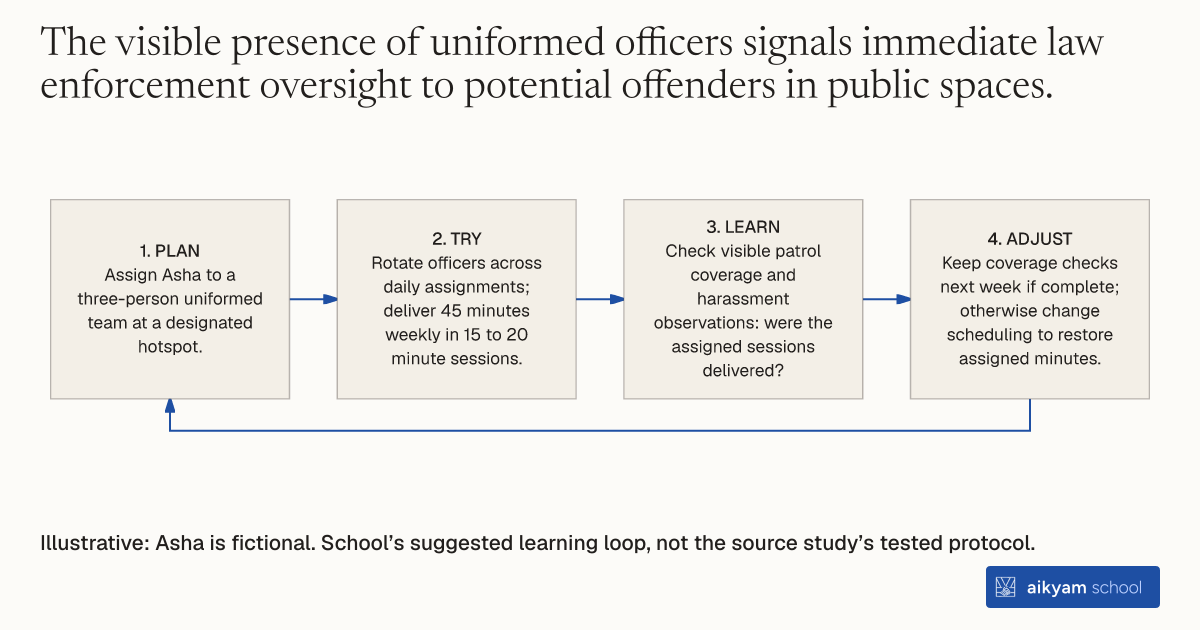
Try, learn and adjust
Check uniformed patrol coverage
- Plan: Assign Asha to a three-person uniformed team at a designated hotspot.
- Try: Rotate officers across daily assignments; deliver 45 minutes weekly in 15 to 20 minute sessions.
- Learn: Check visible patrol coverage and harassment observations: were the assigned sessions delivered?
- Adjust: Keep coverage checks next week if complete; otherwise change scheduling to restore assigned minutes.
Illustrative: Asha is fictional. School’s suggested learning loop, not the source study’s tested protocol.
See source →School’s suggested, untested learning loop. Observe uniformed presence, patrol minutes and harassment; a coverage check does not establish crime effects.
How
When to use
Women frequently experience severe sexual harassment in urban public spaces, limiting their freedom of movement and participation in public life. Traditional covert law enforcement methods focus on apprehending offenders after incidents occur rather than preventing harassment. Deploy visible, uniformed police patrols in high-risk hotspots to deter potential perpetrators and protect women in public areas.
Deploy police officer teams in official uniforms to conduct regular, visible patrols across designated high-risk public locations.
- Assign three-person police teams to designated high-risk harassment hotspots on a weekly schedule.
- Require all patrolling officers to wear official police uniforms during their assigned patrol shifts.
- Schedule patrol teams to conduct 45 minutes of total patrolling per hotspot each week, broken into 15 to 20 minute sessions.
- Rotate individual officers across daily team assignments to maintain coverage.
- Maintain a continuous, visible police presence in public areas to deter potential perpetrators from committing severe offenses.
Why it works
This visible deterrence stops perpetrators from committing severe offenses like stalking or physical intimidation before they occur.
Example
Hyderabad City Police deployed uniformed police teams across 100 randomly assigned harassment hotspots in Hyderabad, India, patrolling each site for 45 minutes weekly over the study period.
About the study
Participants
100 hotspots in Hyderabad, India.
Study Design
A randomized controlled trial evaluating the impact of uniformed police patrols compared to 100 undercover hotspots and 150 unpatrolled comparison hotspots.
Results
Uniformed patrols reduced severe forms of sexual harassment by 27 percent (0.7 fewer women harassed per week per hotspot) and reduced women relocating due to severe harassment by 30 percent.