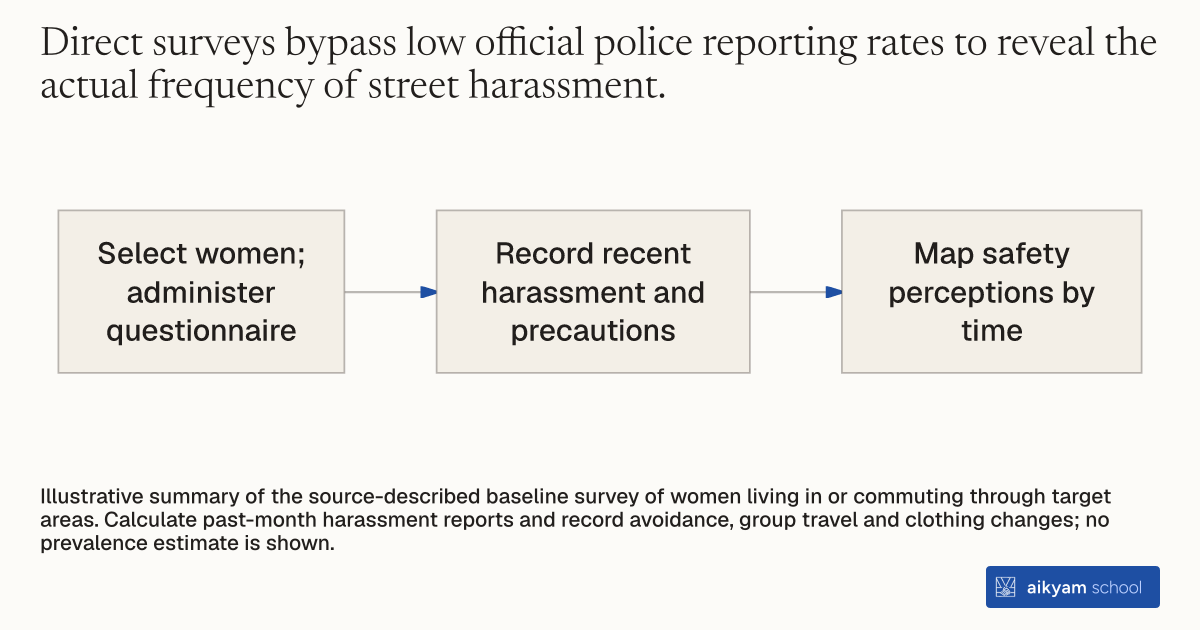
Research steps
Record women’s baseline safety reports
- Select women; administer questionnaire
- Record recent harassment and precautions
- Map safety perceptions by time
Illustrative summary of the source-described baseline survey of women living in or commuting through target areas. Calculate past-month harassment reports and record avoidance, group travel and clothing changes; no prevalence estimate is shown.
See source →How
When to use
Urban public spaces frequently suffer from unreported sexual harassment against women. Standard police records fail to capture true harassment levels because victims rarely report incidents. Run a baseline survey among women to quantify the true prevalence of street harassment and identify underlying safety concerns before launching interventions.
Survey target populations directly at the start of a public safety initiative to gather baseline data on street harassment experiences and safety perceptions.
- Design a structured questionnaire focusing on recent harassment experiences, feeling of safety by time of day, and precautionary behaviors.
- Select a representative sample of women living in or commuting through urban target areas.
- Deploy trained enumerators to conduct individual surveys across selected urban zones.
- Calculate the proportion of respondents experiencing harassment in public spaces within the past month.
- Record specific behavioral adaptations such as avoiding certain locations, traveling in groups, or dressing conservatively.
- Map safety perceptions across time periods to identify high-risk hours across the city.
Why it works
Gathering baseline safety perceptions provides actionable data to design targeted law enforcement interventions.
Example
Researchers surveyed 8,264 women in Hyderabad, India, at the start of a 2019 police patrolling evaluation. The baseline survey revealed that over 30 percent experienced street harassment within the past month, 75 percent felt unsafe moving around after 4 PM, and 87 percent took precautionary measures.
About the study
Participants
8,264 women in Hyderabad, India.
Study Design
A large-scale baseline survey conducted at the beginning of a randomized controlled evaluation in 2019 to measure street harassment and safety perceptions.
Results
Over 30 percent of surveyed women experienced street harassment in public spaces within the past month, 75 percent reported feeling unsafe moving around after 4 PM, and 87 percent took precautionary measures.