Research design
Compare ratings of hypothetical leaders
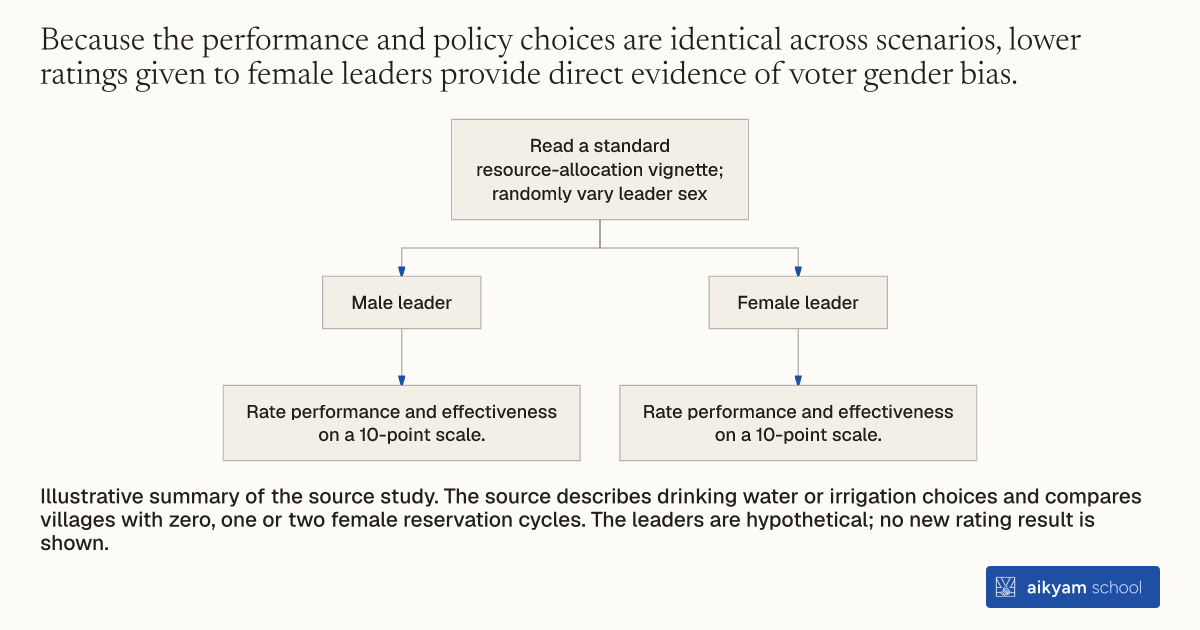
Read a standard resource-allocation vignette; randomly vary leader sex
- Male leader
- Rate performance and effectiveness on a 10-point scale.
- Female leader
- Rate performance and effectiveness on a 10-point scale.
Illustrative summary of the source study. The source describes drinking water or irrigation choices and compares villages with zero, one or two female reservation cycles. The leaders are hypothetical; no new rating result is shown.
See source →How
When to use
Evaluators need to test whether voters evaluate leaders based on gender stereotypes when assessing policy decisions. Actual leader evaluations in real elections are often confounded by party politics, local history, and personal relationships. Presenting standardized hypothetical scenario vignettes with randomly assigned leader genders isolates gender bias in voter evaluations.
Present survey respondents with a standardized vignette depicting a local leader making a resource allocation decision while varying the leader's sex.
- Researchers script a standardized vignette describing a village council leader choosing how to allocate scarce local funds.
- Scriptwriters specify the leader's decision between investing in a drinking water project or an irrigation project.
- Researchers randomly vary the leader's sex in the vignette between male and female across respondents.
- Surveyors read the assigned vignette to each adult respondent during household interviews in Birbhum district villages.
- Interviewers ask respondents immediately after the vignette to rate the leader's performance and decision effectiveness on a 10-point scale.
Example
In Birbhum district, West Bengal, researchers presented decision vignettes to adult respondents across 495 village councils, finding that male villagers in never-reserved villages rated male leaders 1.45 points higher on a 10-point scale than female leaders.
About the study
Participants
Adult male and female respondents surveyed across 495 randomly selected rural villages in Birbhum district, West Bengal, India.
Study Design
Survey experiment embedded in a field trial, randomly varying leader sex and project choice across villages exposed to zero, one, or two cycles of female political reservation.
Results
Male villagers in never-reserved villages rated male leaders 1.45 points higher than female leaders on a 10-point scale, but prior exposure to female leaders reversed this bias among male villagers.