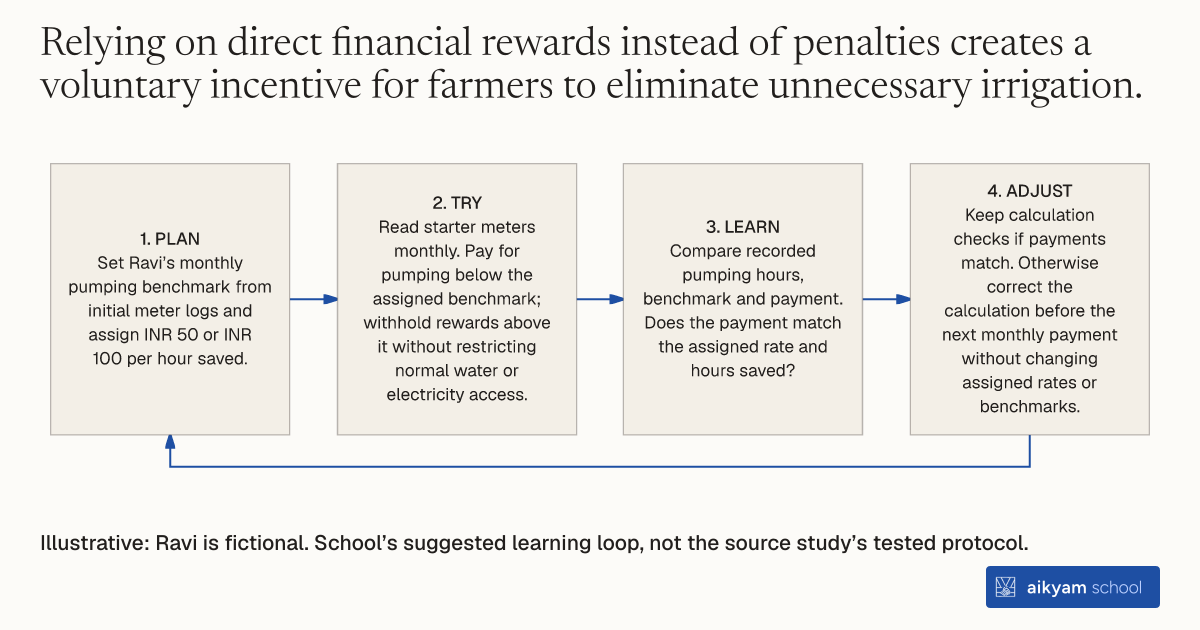
Try, learn and adjust
Check payments follow metered conservation
- Plan: Set Ravi’s monthly pumping benchmark from initial meter logs and assign INR 50 or INR 100 per hour saved.
- Try: Read starter meters monthly. Pay for pumping below the assigned benchmark; withhold rewards above it without restricting normal water or electricity access.
- Learn: Compare recorded pumping hours, benchmark and payment. Does the payment match the assigned rate and hours saved?
- Adjust: Keep calculation checks if payments match. Otherwise correct the calculation before the next monthly payment without changing assigned rates or benchmarks.
Illustrative: Ravi is fictional. School’s suggested learning loop, not the source study’s tested protocol.
See source →School’s suggested, untested loop: observe hours, assigned limits and payments; this check does not establish causal conservation effects.
How
When to use
In semi-arid agricultural regions, subsidized electricity leads to unregulated groundwater pumping and rapid aquifer depletion. Mandating higher energy tariffs or extraction quotas often triggers political opposition from smallholder farmers. Offering voluntary cash payments per hour of reduced pumping provides an effective mechanism to encourage water conservation without harming farmer income.
Offer direct cash incentives to smallholder farmers for every pumping hour conserved below an established monthly benchmark.
- Establish a monthly baseline pumping benchmark for each participating smallholder farmer using initial starter meter logs.
- Assign each participant to a conservation payment rate of INR 50 or INR 100 per hour of pumping saved below their monthly limit.
- Track accumulated pumping hours each month using hours-of-use meters mounted on electric pump starters.
- Distribute monthly cash payments to farmers who maintain pumping below their assigned benchmark quantity.
- Retain normal groundwater and electricity access for farmers who exceed their benchmark while withholding payment rewards for that month.
Why it works
It sidesteps political resistance to power tariff increases while encouraging farmers to adopt water-conserving agricultural practices.
Example
Researchers offered voluntary conservation payments of INR 50 or INR 100 per hour to smallholder farmers in Saurashtra, Gujarat, over three months. Farmers offered these payments reduced groundwater pumping by 10.4 hours per month and decreased electricity consumption by 140 kilowatt-hours per month compared to the comparison group average of 611 kilowatt-hours per month.
About the study
Participants
1,111 smallholder farmers (from a sampling frame of 1,347 farmers across 1,328 water-sharing pools, after 236 attrited) in Saurashtra, Gujarat, India.
Study Design
Randomized controlled trial evaluating four payment intervention groups against a comparison group using pump starter hours-of-use meters monitored monthly from December 2022 to March 2023.
Results
Farmers offered conservation payments decreased groundwater pumping by 10.4 hours per month (22 percent) and lowered monthly electricity consumption by 140 kilowatt-hours (23 percent) relative to the comparison group average of 611 kilowatt-hours per month.