Research procedure
Screen farms for groundwater monitoring
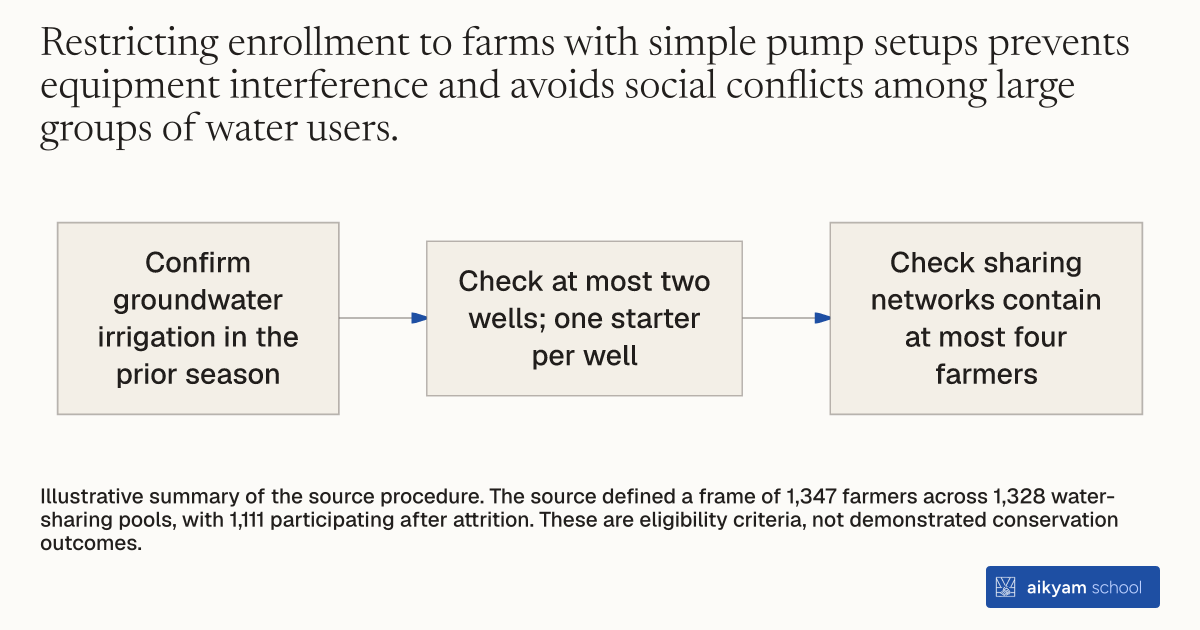
- Confirm groundwater irrigation in the prior season
- Check at most two wells; one starter per well
- Check sharing networks contain at most four farmers
Illustrative summary of the source procedure. The source defined a frame of 1,347 farmers across 1,328 water-sharing pools, with 1,111 participating after attrition. These are eligibility criteria, not demonstrated conservation outcomes.
See source →How
When to use
In semi-arid agricultural regions, unmonitored tubewell pumping drains groundwater aquifers. Program managers face the challenge of selecting suitable farms where energy conservation incentives can be measured effectively. This screening method identifies smallholder farmers who have manageable well setups and simple irrigation arrangements.
Screen agricultural applicants against technical and infrastructural criteria before enrolling them in groundwater monitoring programs.
- Survey local agricultural producers to confirm that they planted and irrigated crops primarily using groundwater during the previous season.
- Inspect farm sites to verify that each applicant operates a maximum of two active wells on their land.
- Check electric switchboards to ensure that applicants use no more than one pump starter per active well.
- Evaluate water-sharing networks to select only farms that share irrigation sources among four or fewer farmers.
Why it works
Clear technical criteria ensure that installed meters capture accurate pumping data.
Example
Researchers screened smallholder farmers in Saurashtra, Gujarat, who primarily grew water-intensive crops like cotton. They built a sampling frame of 1,347 eligible farmers across 1,328 water-sharing pools with four or fewer members per pool.
About the study
Participants
1,111 smallholder farmers (from a sampling frame of 1,347 farmers across 1,328 water-sharing pools, after 236 attrited) in Saurashtra, Gujarat, India; most participants were literate and completed primary and secondary school.
Study Design
A randomized controlled trial evaluated voluntary conservation payments using pump starter hours-of-use meters on eligible smallholder tubewells from December 2022 to March 2023.
Results
Enrolled farmers offered conservation payments reduced electricity consumption by 140 kilowatt-hours per month (23 percent) and lowered pumping by 10.4 hours per month compared to the comparison group average of 611 kilowatt-hours per month.