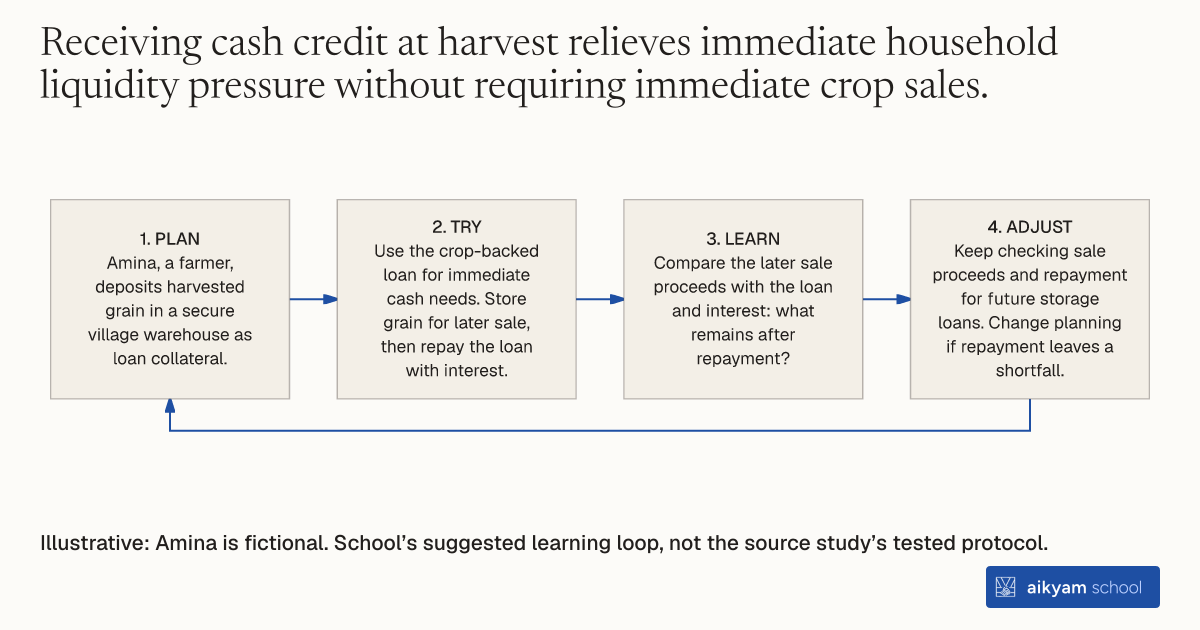
Try, learn and adjust
Check stored grain supports loan repayment
- Plan: Amina, a farmer, deposits harvested grain in a secure village warehouse as loan collateral.
- Try: Use the crop-backed loan for immediate cash needs. Store grain for later sale, then repay the loan with interest.
- Learn: Compare the later sale proceeds with the loan and interest: what remains after repayment?
- Adjust: Keep checking sale proceeds and repayment for future storage loans. Change planning if repayment leaves a shortfall.
Illustrative: Amina is fictional. School’s suggested learning loop, not the source study’s tested protocol.
See source →School's suggested, untested loop: observe stored grain, sale proceeds, interest and repayment; higher later prices are not guaranteed.
How
When to use
Small-scale farmers face acute post-harvest cash shortages, forcing them to sell crops immediately when market supply surges and prices hit seasonal lows. Without access to credit or safe storage, producers cannot wait for off-season price increases. Warrantage provides microcredit backed by stored grain collateral so farmers can delay crop sales until market prices recover.
Provide harvest-time credit collateralized by stored grain in secure village warehouses to allow smallholders to sell crops off-season.
- Construct or secure certified village warehouses for safe crop storage.
- Deposit harvested grain in the warehouse as collateral immediately following the harvest season.
- Obtain a microcredit loan backed by the value of the deposited crop to cover immediate cash needs.
- Hold the grain securely in storage while waiting for off-season market prices to peak.
- Sell the stored crop later in the season when prices rise, repay the loan with interest, and retain the remaining profit.
Why it works
Holding grain in secure storage allows farmers to capture higher off-season market prices and increase overall crop revenue.
Example
In Burkina Faso, smallholder farmers stored harvested grain as collateral in secure warehouses to obtain cash credit. Farmers delayed their grain sales until later in the season, increasing crop revenues by 15 percent, which equaled approximately US$235 per household.
About the study
Participants
Smallholder grain farmers in Burkina Faso.
Study Design
Randomized Evaluation (RCT).
Results
Access to credit with grain stored as collateral in secure warehouses enabled farmers to sell grain later in the season, resulting in a 15 percent increase in crop revenues (about US$235).