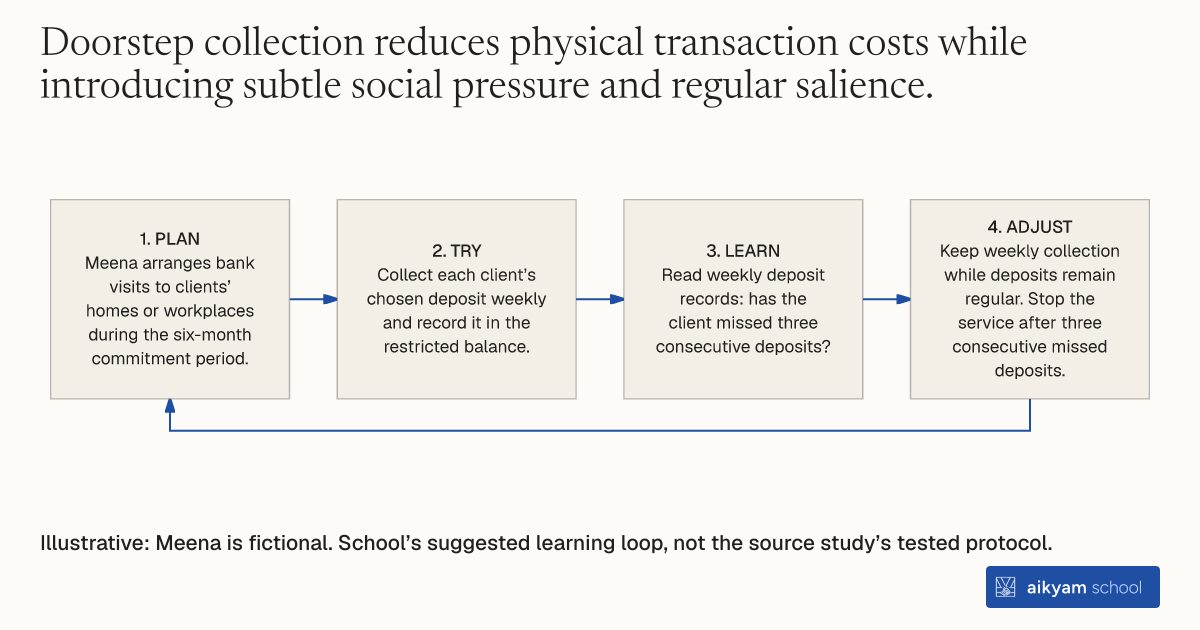
Try, learn and adjust
Check weekly doorstep deposits
- Plan: Meena arranges bank visits to clients’ homes or workplaces during the six-month commitment period.
- Try: Collect each client’s chosen deposit weekly and record it in the restricted balance.
- Learn: Read weekly deposit records: has the client missed three consecutive deposits?
- Adjust: Keep weekly collection while deposits remain regular. Stop the service after three consecutive missed deposits.
Illustrative: Meena is fictional. School’s suggested learning loop, not the source study’s tested protocol.
See source →School’s suggested learning loop checks deposit records, separately from the tested collection service.
How
When to use
Participants in savings programs often fail to make regular deposits due to high transaction costs and procrastination. Offering a personal doorstep deposit collection service provides routine reminders and convenience for individuals trying to build commitment balances. It helps program managers increase enrollment and deposit frequency among participants who struggle with self-control.
Send a bank employee to collect regular commitment deposits directly from clients at their homes or workplaces.
- Assign a bank employee to visit each participating client once every week during the six-month program.
- Collect the client's self-selected cash deposit during the weekly doorstep visit.
- Record each collected deposit directly into the client's restricted commitment savings balance.
- Continue weekly visits for the full six-month commitment period as long as deposits remain regular.
- Terminate the home collection service if a client misses three consecutive weekly deposits.
Why it works
Visiting clients weekly reminds them of their commitment goals and makes saving effortless compared to visiting a distant bank branch.
Example
Green Bank offered weekly deposit collection to 640 targeted smokers in the Philippines, resulting in 76 account sign-ups compared to only 6 sign-ups among 141 smokers offered accounts without collection services.
About the study
Participants
781 adult regular smokers offered commitment accounts in Mindanao, Philippines, where participants averaged 37 years of age and smoked 14 cigarettes per day.
Study Design
Randomized trial comparing commitment account take-up and savings behavior between smokers offered weekly deposit collection services and those required to deposit at bank branches.
Results
Offering weekly deposit collection increased commitment account take-up from 4.3 percent to 11.9 percent, though 64 percent of clients eventually lost the service by missing three consecutive weekly deposits.