In Simple Words
Instead of asking awkward questions out loud in front of peers or a local teacher, students log into a private digital suggestion box. A trained professional sitting in a distant office answers their personal messages confidentially, creating a safe wall of privacy that encourages honest inquiry.
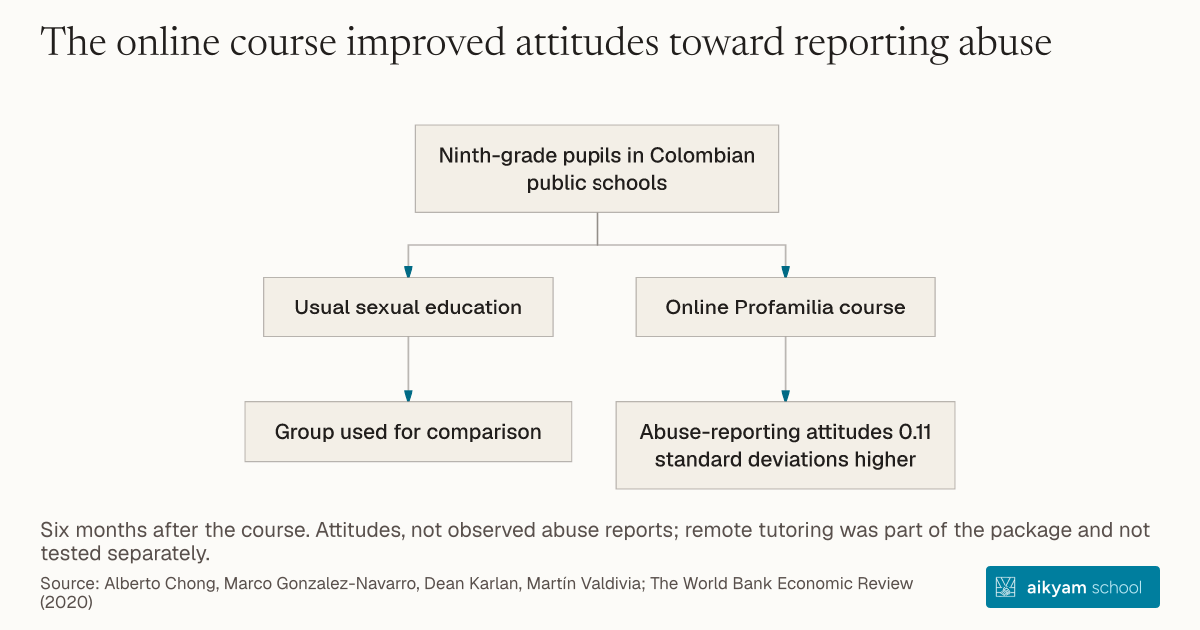
Ninth-grade pupils in Colombian public schools
- Usual sexual education
- Group used for comparison
- Online Profamilia course
- Abuse-reporting attitudes 0.11 standard deviations higher
Six months after the course. Attitudes, not observed abuse reports; remote tutoring was part of the package and not tested separately.
See source →Research question
Adolescents frequently hesitate to seek accurate sexual health information or ask sensitive questions due to fear of social stigma, privacy breaches, or judgment from local schoolteachers and authority figures.
Participants
N = 1,522 treatment students in 46 classrooms across 21 urban Colombian public secondary schools.
Study Design
Classroom-level RCT integrating password-protected accounts with dedicated, off-site Profamilia tutors providing asynchronous messaging and performance monitoring during an 11-week curriculum.
Results
Facilitated course completion and remote interaction, contributing to a 0.11 SD increase in willingness to report sexual abuse (p < 0.05) and a 0.26 SD increase in abuse reporting attitudes (p < 0.01) six months post-intervention.
Takeaway
Structure digital health interventions with off-site, anonymous remote counselors rather than local classroom teachers to eliminate social stigma during sensitive Q&A sessions.
Source and citation
See source →Read alongside the research
Plain-English glossary
Original explanations, informed by the references below. Examples are illustrations, not data from the studies above. The research text stays unchanged.
- Randomized controlled trial
A study that uses chance, like drawing lots, to decide who receives each option being compared. Researchers compare the groups’ outcomes to estimate the effect of those options.
ExampleA lottery assigns volunteers to a training programme or a comparison group. Researchers then compare their outcomes.
GET-IT glossary · Randomized study ↗Read more about randomized controlled trial →