In Simple Words
It is like bidding on a car warranty where buyers pay slightly more for a policy covering flat tires but fail to realize that another policy covering total engine failure is worth ten times more money.
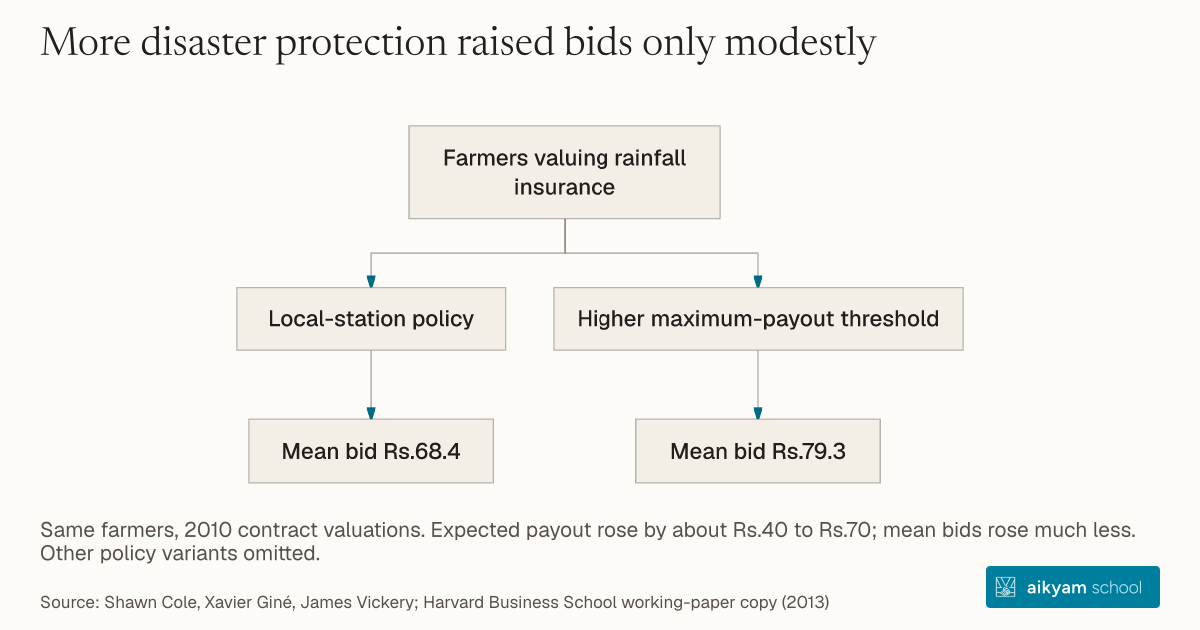
Farmers valuing rainfall insurance
- Local-station policy
- Mean bid Rs.68.4
- Higher maximum-payout threshold
- Mean bid Rs.79.3
Same farmers, 2010 contract valuations. Expected payout rose by about Rs.40 to Rs.70; mean bids rose much less. Other policy variants omitted.
See source →Research question
Consumers evaluating complex financial insurance contracts recognize qualitative value changes but struggle to correctly estimate the economic magnitude of specific contract terms relative to actuarial risk.
Participants
N = 1,978 farmers in Andhra Pradesh, India bidding on four distinct insurance contract variations.
Study Design
Incentive-compatible Becker-DeGroot-Marschak (BDM) field experiment eliciting willingness to pay across systematic contract term modifications.
Results
Raising the exit threshold increased willingness to pay by Rs. 11 despite increasing expected payout by Rs. 40–70, whereas reducing millimeter deficit payments reduced willingness to pay by Rs. 12–13 while only lowering expected payout value by Rs. 10–20.
Takeaway
Regulate and standardize retail index insurance contract parameters to prevent commercial insurers from offering policies that exploit consumer misvaluation of severe tail events.