In Simple Words
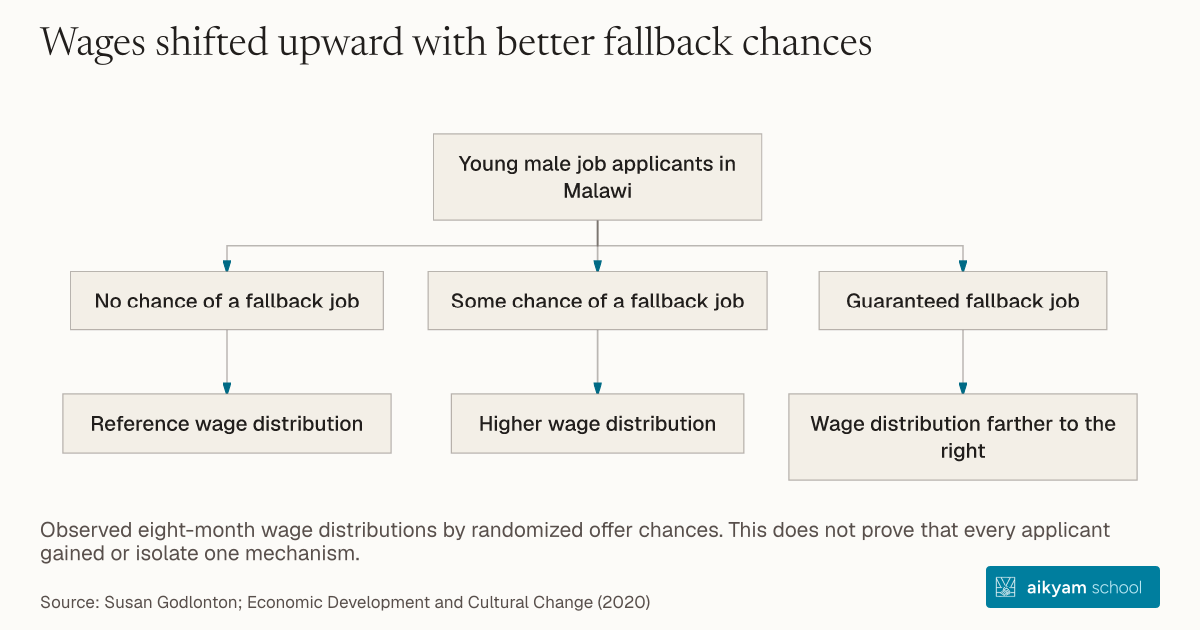
A short-term work experience intervention acts like raising the water level in an entire harbor rather than lifting a single boat. It shifts the entire cumulative distribution curve of daily wages to the right, increasing earnings opportunities across low-, medium-, and high-earning workers alike.
Young male job applicants in Malawi
- No chance of a fallback job
- Reference wage distribution
- Some chance of a fallback job
- Higher wage distribution
- Guaranteed fallback job
- Wage distribution farther to the right
Observed eight-month wage distributions by randomized offer chances. This does not prove that every applicant gained or isolate one mechanism.
See source →Research question
Evaluating whether wage increases from active labor market interventions reflect broad earnings gains across worker cohorts or are skewed by extreme outlier earnings among a few top individuals is critical for policy evaluation.
Participants
N = 227 urban Malawian male job seekers tracked over an 8-month follow-up period in Lilongwe, Malawi.
Study Design
Instrumental variables (IV) estimation combined with cumulative distribution function (CDF) analysis comparing post-intervention daily wage distributions across lottery job, earned job, and control groups.
Results
Wage gains persisted consistently across all 8 post-intervention months ($1 to $6 per day increase across individual months), displaying a rightward shift of the entire daily wage CDF rather than earnings concentration among a few top earners.
Takeaway
Plot cumulative distribution functions of wage outcomes when evaluating employment interventions to confirm that wage growth is broad-based across all income quantiles.
Source and citation
See source →Read alongside the research
Plain-English glossary
Original explanations, informed by the references below. Examples are illustrations, not data from the studies above. The research text stays unchanged.
- Follow-up
Collecting more information about participants later in a study to see what has happened to them. The term can also mean the length of time researchers keep track of them.
ExampleResearchers interview the same workers three months after a programme ends. That later interview is a follow-up.
GET-IT glossary · Follow-up ↗Read more about follow-up →