In Simple Words
Joining a short-term workplace is like gaining access to a private neighborhood bulletin board where members continuously share tips about upcoming job openings, allowing newly connected workers to hear about employment opportunities that are never publicly advertised.
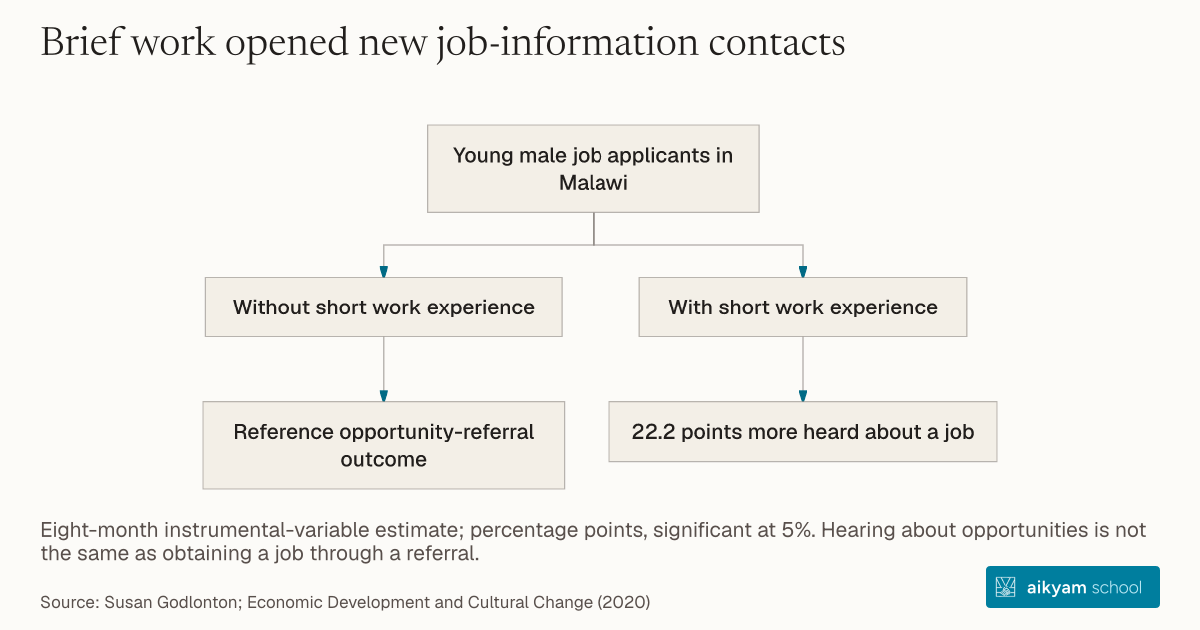
Young male job applicants in Malawi
- Without short work experience
- Reference opportunity-referral outcome
- With short work experience
- 22.2 points more heard about a job
Eight-month instrumental-variable estimate; percentage points, significant at 5%. Hearing about opportunities is not the same as obtaining a job through a referral.
See source →Research question
Job seekers in low-income urban labor markets frequently face informational bottlenecks and limited employment channels, restricting their access to unadvertised vacancy listings.
Participants
N = 215 urban Malawian male job seekers surveyed at the 8-month follow-up in Lilongwe, Malawi.
Study Design
Instrumental variables (IV) regression model estimating the effect of acquiring 5 days of work experience on social job network interactions and referral channels.
Results
Acquiring short-term work experience increased the probability of receiving any job referral by 22.2 percentage points (p < 0.05) and increased the overall social network index by 0.306 standard deviations (p < 0.10) over the 8-month follow-up period.
Takeaway
Structure active labor market programs to incorporate collaborative tasks and supervisor interactions that foster informal job referral connections among participants.
Source and citation
See source →Read alongside the research
Plain-English glossary
Original explanations, informed by the references below. Examples are illustrations, not data from the studies above. The research text stays unchanged.
- Follow-up
Collecting more information about participants later in a study to see what has happened to them. The term can also mean the length of time researchers keep track of them.
ExampleResearchers interview the same workers three months after a programme ends. That later interview is a follow-up.
GET-IT glossary · Follow-up ↗Read more about follow-up →- Percentage points
The difference between two percentages.
ExampleA rise from 40% to 50% is 10 percentage points. Relative to the starting value, that is a 25% increase.
Office for National Statistics · Percentages ↗Read more about percentage points →